By Rain Madrone

Editor’s Note: This interview was conducted as an assignment for Kathy Geritz’s Film 28B (Avant-Garde Film) class at University of California, Berkeley, circa 1997. It is published with the permission of the author.

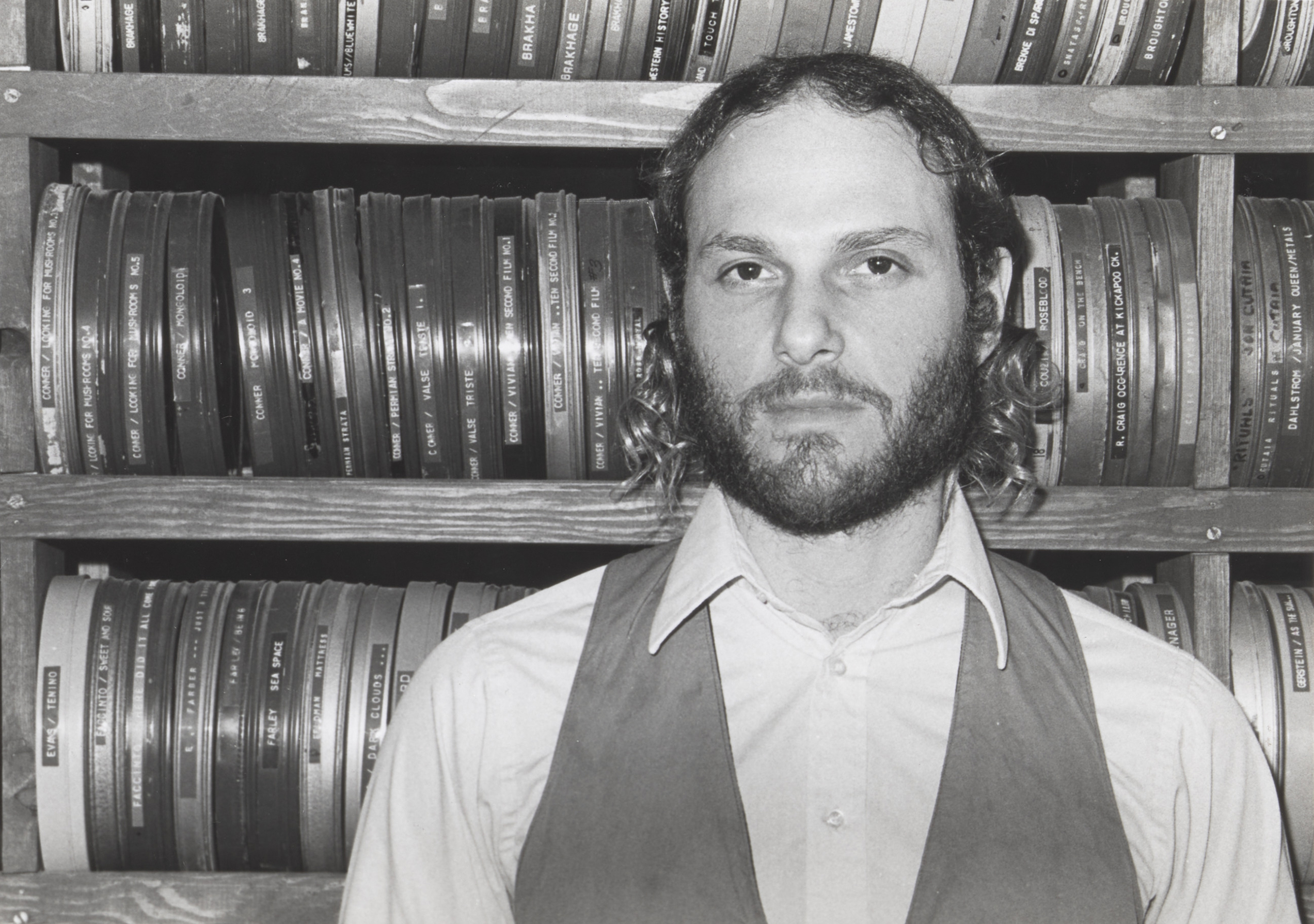
Before I was assigned the project of interviewing a local filmmaker, I was not familiar with San Francisco filmmaker Michael Wallin or his work. Upon the suggestion of my professor, I watched Decodings, Wallin’s award-winning 1988 film. Assembled from found footage of the 1950s, and accompanied by voice-over narration, Decodings is an examination of (among other things) the issues involved with masculine maturation and friendship. After viewing the film, I was sure that I could find more than enough to talk about with this filmmaker to fill a short interview.
After a brief phone conversation, I ventured into San Francisco to meet Michael Wallin. We met, set a time for the interview, and he gave me copies of several of his other movies, as well as a variety of news clippings on his work. The tapes that he gave me covered several decades: The Place Between Our Bodies (1975), Monitoring the Unstable Earth (1980), Fearful Symmetry (1981), Along the Way (1983), and Black Sheep Boy (1995). Wallin’s films cover a variety of subjects and styles, ranging from the raw sexual imagery of The Place Between Our Bodies to the more abstract/collage material of a film like Fearful Symmetry. Watching Wallin’s films does not allow one to easily place him into any category, except perhaps for “experimental filmmaker.” That diverse, hard-to-classify quality to his work also led me to believe that Wallin would have plenty to say about any number of subjects. I was not to be disappointed on that count.
Over the course of an approximately hour-long conversation in the kitchen of his San Francisco home Wallin and I spoke about many things, including the films that I had watched, along with more general areas of his film style and background. What follows is an excerpt of our much lengthier interview.

Rain Madrone: Could you talk a little about how you got into film? Was it something that you always knew you wanted to do, or did you stumble into it?
Michael Wallin: It wasn’t something that I always knew I wanted to do. I sort of stumbled into it. I went to college at Yale as an undergraduate, and I was looking around for some courses that weren’t too academic, to balance all the academic courses, and there was a beginning film production course. So I took that, and I made my initial stabs at making films. Then at the same time, when I was at Yale, I was really lucky, because the guy who’s now considered the main theorist and writer for avant-garde cinema, P. Adams Sitney, was a graduate student when I was an undergraduate. He was head of what was called the Experimental Film Society, and he brought in from New York and all over the country experimental films that were just incredible, because I’d never really seen [films like that]. There were two instances prior to that. One was when I think I was still in high school, and there were cinemas in San Francisco that were showing experimental short films. There was one theater, I think it was in North Beach, that was showing films by Kenneth Anger. So I saw Scorpio Rising [1963] –
RM: We just watched that in class today.
MW: I was only in high school, and I loved it. It’s wonderful. The other exposure was to a film called Un chant d’amour [1950] by Jean Genet. It means “A Song of Love” in French, and it’s the only film he ever made; he’s a very famous French writer. The film had been banned because of its homoerotic content…
RM: Were you out at the time?
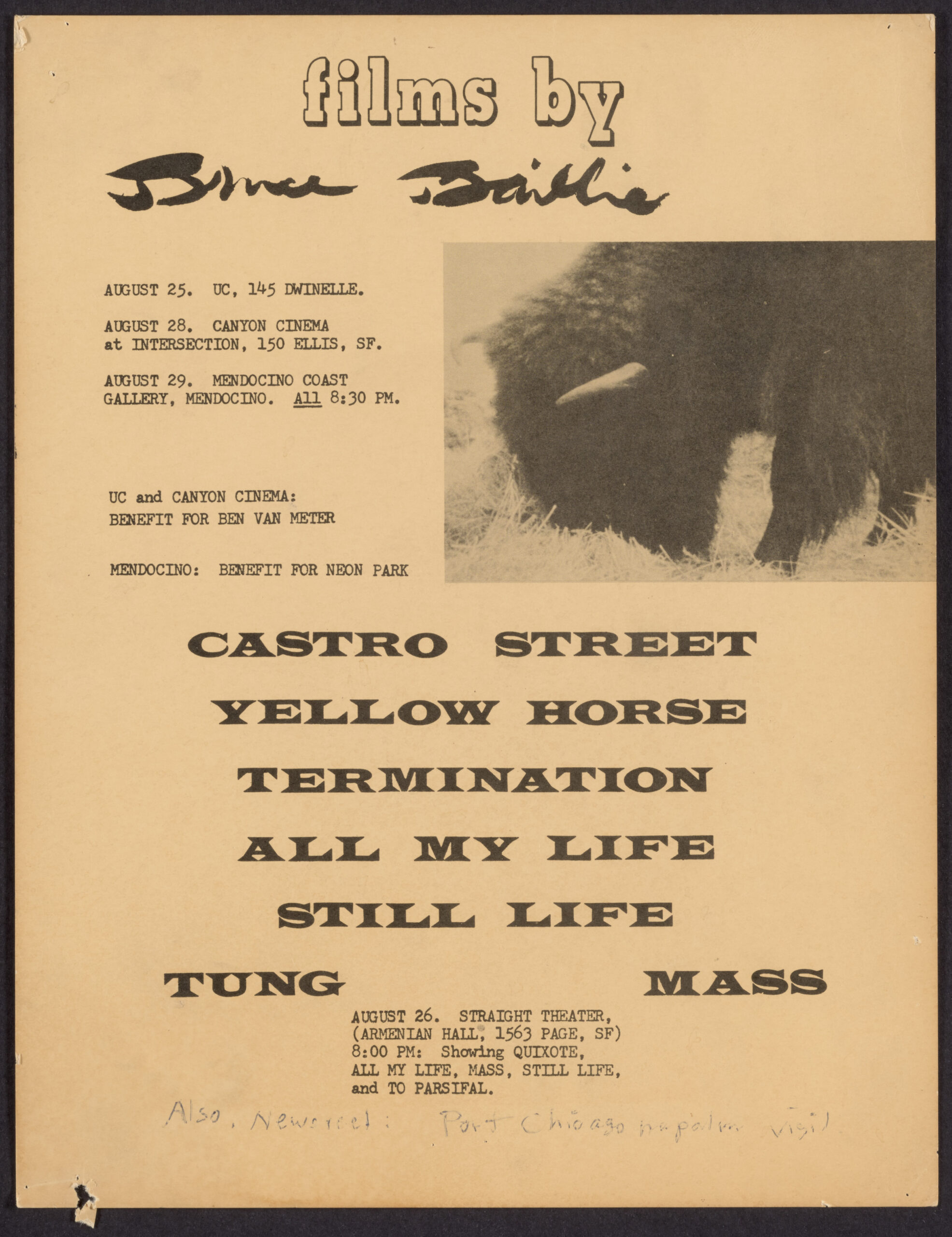
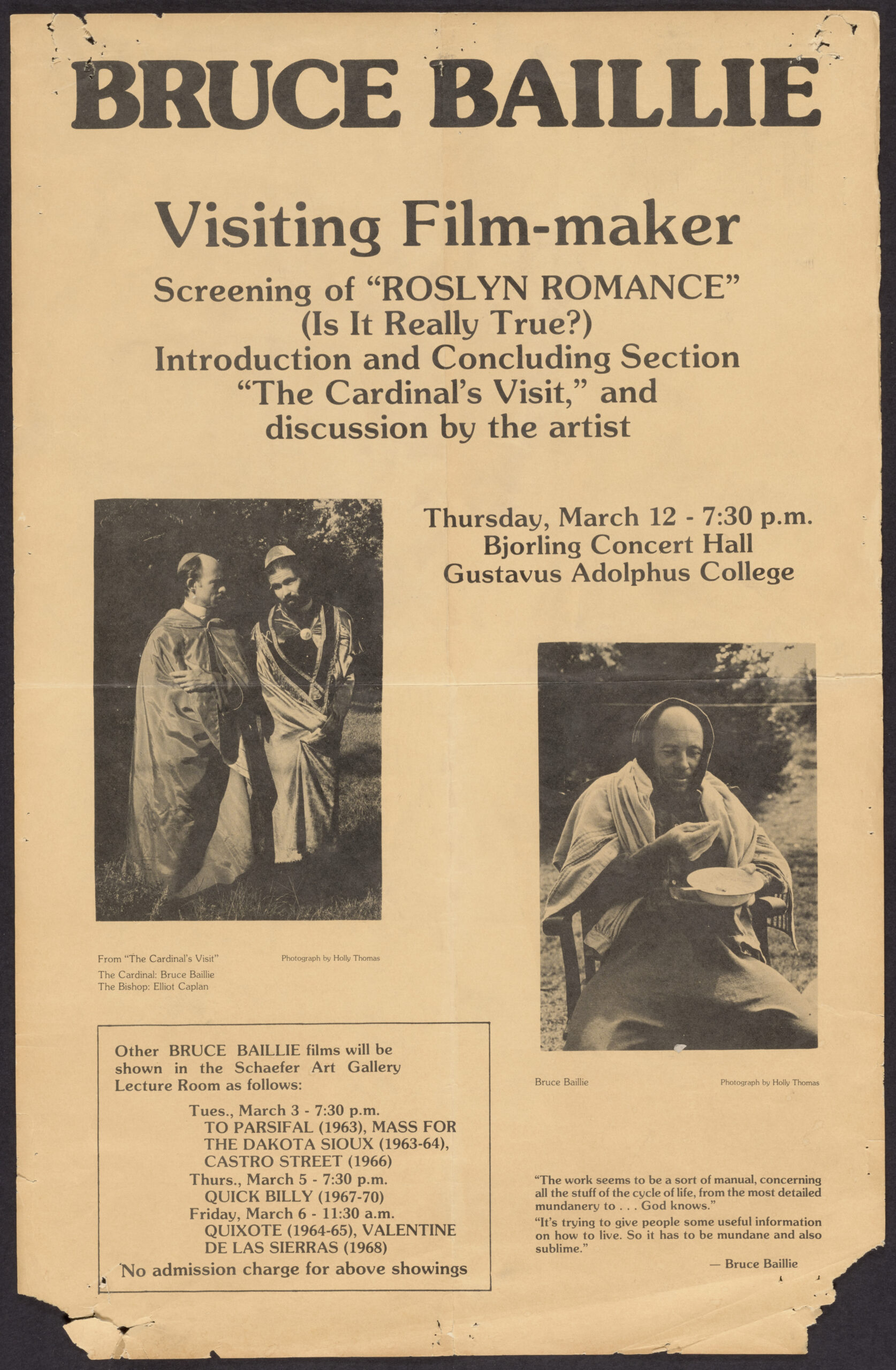
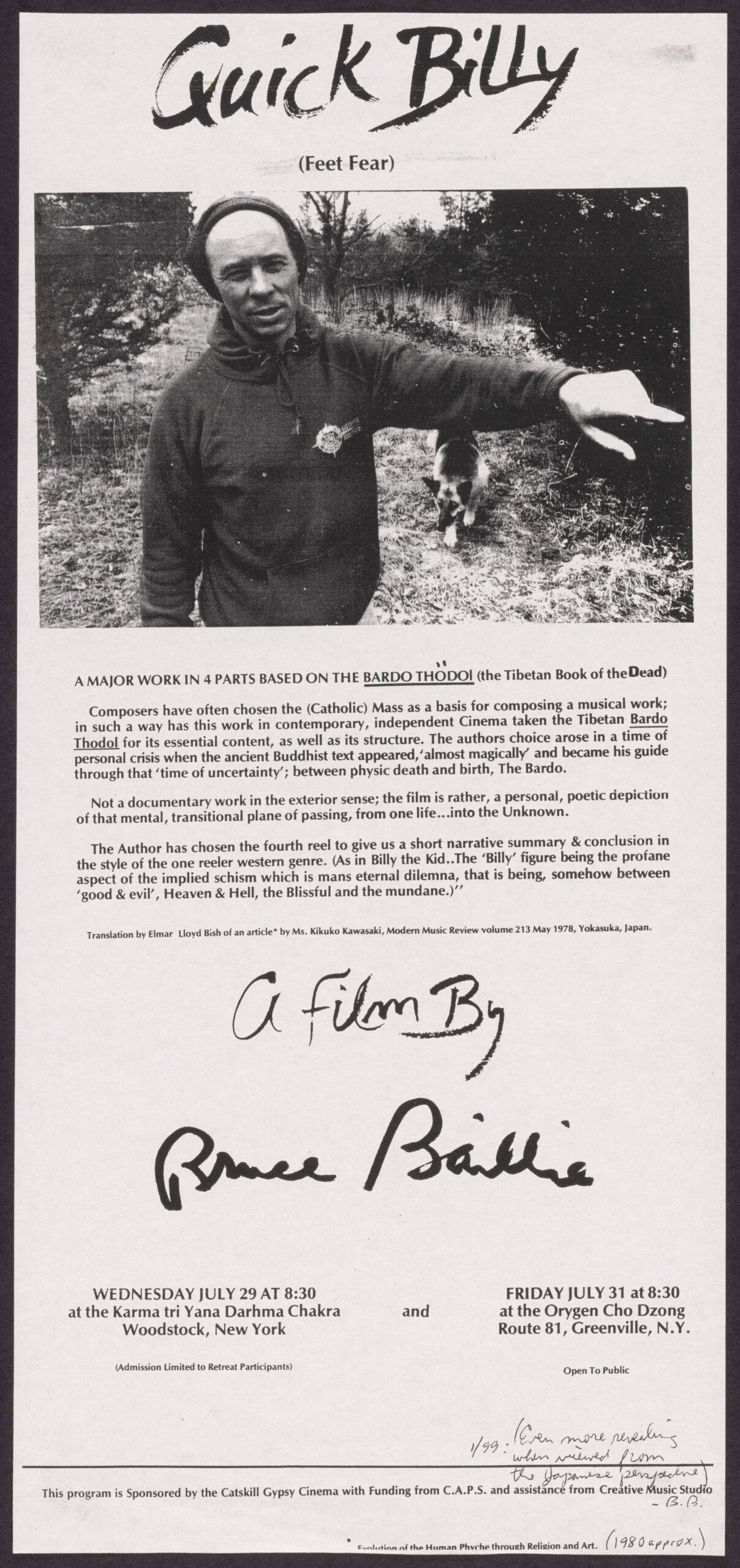
MW: No, I wasn’t. The film was banned, but it was rereleased during the mid-sixties, and my parents, who were very anxious that I be exposed to a lot of different cultural events, decided to take me. My brother wasn’t there for some reason. My father and I went to see this film. I don’t think he knew what he was exposing his son to at the time [laughs]. But this was an experimental film; a very potent, very powerful, very moving film, and it really shook me up. So, it was kind of like [through] those experiences at Yale, and seeing those films, and taking that course, I started getting interested [in film]. The other part of that was seeing a number of films by a filmmaker named Bruce Baillie, who’s one of the important people in the avant-garde. The summer between my sophomore and junior years in college I noticed he was teaching a course at the Mendocino Arts Center in film, so I just decided to take the course. I was sort of in awe of this man, who seemed so connected to his camera. He sort of became my mentor, so that was a turning point as well.
RM: Did you just jump right in? Was there ever a phase where it was just a hobby, or did you get interested and then it became what you did?
MW: Well, I guess you could use the word hobby, even though I still thought of it more as an art form, or art-making, when I was doing those little films at Yale. But then I made my first films that summer when I studied with Bruce. I made a couple films that are considered part of the body of my work. I made them in 8mm and then had them blown up to 16. So it was never really a hobby, exactly. When I was a kid, my family went on vacations to Europe, and I was the designated travel photographer, so I took most of our home movies. Maybe that was the beginning, the real beginning.
RM: I was also curious about the process you go through making films. Do you start with a specific idea, or are you shooting all the time, and that later turns into [a film]?
MW: Kind of both. The first films I made when I was a graduate film student at San Francisco State were definitely pre-planned. Or in other words, I started out with an idea, and then I executed the idea, allowing for a lot of improvisation and spontaneity in the filming and editing. But I definitely had an idea before. There are two films: one is called Kali’s Revue [1972], Kali being the Hindu god of [pauses] this or that, sort of a spiritual piece. The other one was called Sleepwalk [1973]. It was about what we are as humans and our gestures—I don’t want to talk a lot about that, it was too long ago. I still show that. I actually showed that a couple nights ago [laughs] at an open screening for this cinema [No Nothing Cinema] that’s dying because the San Francisco Giants ballpark is going to be built on top of it. We had some final screenings. Anyway, then there was this series of three films, which you saw, Monitoring the Unstable Earth, Fearful Symmetry, and Along the Way. [For] those films I basically just collected footage. I just carried my camera with me when I went on trips out-of-town, or sometimes I would come upon just interesting things here in San Francisco, and film them. So I gathered footage, and at a certain point I realized “oh yeah, I have a film here,” and from that point I started to edit the footage with the conception I had developed around what the film was going to be like. So, [I work] both ways. Especially now, with my last couple of films. Decodings also worked in that fashion. I didn’t really know what the film was going to be, I just started pulling interesting shots from all this found footage.
RM: I was wondering how you would classify your films. Do you see your movies as filling a particular genre?
MW: The word that’s used most frequently is experimental. For example, when you get applications to submit films for festivals, they say “narrative, documentary, experimental.” Over the last thirty years or so that I’ve been involved with this kind of filmmaking all sorts of words have been used. Avant-garde is another. You’re taking avant-garde cinema [class]. Avant-garde, experimental, visionary, underground, personal…
RM: I was going to ask you if you’ve ever wanted to work in another genre, to make a strict narrative or a documentary. But then I was thinking that a lot of these films are documentaries, just not in the conventional sense.
MW: Right, they’re experimental, personal documentaries. Was that a question?
RM: Do you have the desire to make other styles of film?
MW: Initially, when I was in film school, I kind of did. I knew I wanted to make shorter, more personal experimental films as well, but I kind of did. But I also felt like I didn’t quite have the temperament to make an independent feature film, even if it wasn’t going to be commercial. Somehow, the notion of making films that would involve many, many other people, in lots of different capacities, and having to direct all these people… all of this seemed sort of daunting to me. I generally prefer to work alone. Although now, film is one thing I do, and I have a whole other life. Now that I’ve went into this second career, I basically don’t have the time.
RM: What is that second career?
MW: Eight years ago, I went back to graduate school for a second time, in psychology. I’m finishing up now. I have the degree, and I’m finishing all the internship requirements to be a psychotherapist.
RM: Is that a “making a living” kind of choice?
MW: It came about because at the time I had been doing a number of things in film, not only the making of films, but some teaching of film, which I’m doing again now. I also ran my own company as a negative cutter, which is the last step in the process of preparing a film for printing, and which is amazingly tedious. The person I bought the company from described it to me rather romantically, saying “this is the zen of film making.” The money was okay, but it was just so tedious that I could only do that for a few years without just completely going crazy. So, basically, I was at a point where I wasn’t really getting any more teaching jobs, which I would have liked to continue getting, my films weren’t really getting shown… I’d had a lot of my work shown in group shows and some one person shows, I’d done tours with my work, but I just felt like for all the work that I was putting into the films the extent they were being shown wasn’t gratifying enough. But it mostly did have to do with making money.
RM: If you had a choice, would you just be making movies, rather than getting another career?
MW: I don’t know. I actually like doing psychotherapy a lot. I was interested in doing something that was more intellectually challenging and that was more directly involved with people.
RM: Does it fill something [in your life] that filmmaking doesn’t?
MW: Yeah, it’s sort of a nice balance. It fills these other needs that I have, and it’s gratifying in different ways. I’m not making a living at it yet. I’m doing internships, which pay nothing.
RM: Are you going to be a psychotherapist who makes films, or a filmmaker who does psychotherapy on the side?
MW: That’s a good question. My goal is to be both. I want to have a private practice, continue to teach film like I have been for the past few years, and then make films when I have the money to make them. So I would say the answer would be neither. Both.
RM: You mentioned that you like to work alone, and in a lot of the literature on Decodings they talked about how that was your first collaboration. But in almost all the other films there was another writer involved. Would you say that it’s accurate when they call Decodings your first collaboration?
MW: I do think it’s accurate.
RM: Or is it just a matter of semantics?
MW: No, it’s much more than semantics. It truly was my first real collaboration, because in the other films… Say, in Along the Way, where there are monologues, the people who spoke them wrote them and I made some alterations, but it wasn’t really like they were working with me. They were providing me with an element, like the use of music. But it wasn’t as if they were actively collaborating. So with Decodings, when I worked with Michael Blumlein, it was a real collaboration, because I gave him all this written material: dreams, fantasies, characters, ideas, around which I asked him to develop some specific semi-narrative story lines. Then he gave those back to me and I reworked them, and he reworked them, and he watched the imagery in its raw form to work off of. It was much more back-and-forth.
RM: Why don’t you write for your own films?
MW: I tried with Decodings, and I realized I’m not very good. Well, I’m an okay writer, but it seemed like my strength is more in images, visually and in editing.
RM: It just seems to me because they’re such personal films, maybe another person wouldn’t be able to get at your exact idea.
MW: Actually, I felt in both cases that they did. With Decodings, and even more with Black Sheep Boy, I decided that I wanted more collaboration. Now I’m interested in collaboration, more than I ever was. I feel that while I can retain the final say, or the final creative power over the work, I actually like bringing in different voices. For example, I wanted original music for Decodings, and I tried and tried to work with different musicians, and nothing seemed to work. I ended up using the Shostakovich piece, which is perfect. But for Black Sheep Boy I was determined to have original music, and there was a composer who was recommended to me, and I ended up using him. He used some local musicians, from different bands, and I think the musicians are really, really good; people from a group called the Broun Fellinis and another group called Club Foot Orchestra. While I wasn’t absolutely satisfied with every piece of music he produced, overall I was reasonably [pleased].
RM: Are there going to be new forms of collaboration?
MW: I might work with more actors. I have a project in mind that I’ve applied for a Guggenheim Fellowship for. There’s very little grant money left out there, and I was lucky to get all the grants for Black Sheep Boy while they were still around. But I was going to say that in terms of collaboration, the writer I worked with on Black Sheep Boy, named Stephen Beachy… In some ways he was appropriate, because he’s much younger than Michael Blumlein, who’s my age. Stephen Beachy’s about twenty years younger. He had written a really good novel that I had noticed, called The Whistling Song [1991], and he was recommended to me. Our collaboration was incredibly smooth, compared to my work with Michael. He was wonderful to work with, and I thought he really did get it. I just felt that he added an important element to the film. I wrote some of the pieces in a raw form, and he reworked them. I gave him the elements, the storyline, the incidents, and he hammered it into more literary, poetic form.
RM: Does that make you second-guess your old work at all? Do you feel like they could have been better with collaboration?
MW: I don’t know. Conceivably, but they wouldn’t have been the same. They wouldn’t have been as charming, or raw, or innocent. My whole approach to art-making has shifted dramatically, say from when I made The Place Between Our Bodies to Black Sheep Boy. I’m sure you saw that, in that the styles of the films are completely different, even though some of the thematic concerns were similar.
RM: The Place Between Our Bodies is very striking, in the fact that it’s pretty uncommon to see such graphic sexuality [on film], and I have to admit that especially in the last scene it made me pretty uncomfortable. It wasn’t just because it was sex, and it wasn’t just because it was sex between two men, it was just such a private moment. It felt like it was such personal material. How do you feel about the fact that you put such a private moment on film and presented it?
MW: First of all, I would never make that film again, sitting here twenty years later. For me, not only is there that pure sexuality with my lover, the whole film has that raw confessional tone. I stand by the film. For a lot of people, it’s almost their favorite film of mine, because of that, but it makes me uncomfortable sometimes just to experience that film again. It came out of a time in my life in which I could make that film, and wanted to make that film, but I would never make that film again. That’s why, as I see it, a film like Black Sheep Boy has more artistic distance. Still, people say it’s very revealing. And it is, but it’s more like it’s in the third person.
RM: I felt like in the structure of The Place Between Our Bodies, it transitioned from more general, anonymous footage into the private personal moments. Was that by design?
MW: Oh, absolutely. That was the way my life went at that point. I was sort of chronicling my life as a young gay man, exploring what it was like not having a boyfriend, but looking for sex and fantasizing about different kinds of men. And then finding a boyfriend, and contrasting that experience. In a way, I feel that the film is a little on the self-indulgent side, that it might be tighter if I made it again.
RM: As far as the connection with Black Sheep Boy, was that something where you said “twenty years ago I made an examination of my sexuality, now I will do that again”?
MW: Not really, no. It was more like as I was making Black Sheep Boy I realized there were commonalities somehow thematically.
RM: Do you feel that they are connected beyond just that that is the general subject matter?
MW: Oh, yeah. Some of the spoken vignettes in Black Sheep Boy over the images, are again returning, with a somewhat different bent, to the themes around sexual fantasy and desire. But it’s both more specific and less specific. It’s more specific in that in certain sections of the film it deals with the psychology of how we project certain idealized qualities onto this person we don’t know. What kind of connection does that create? What is lost there, in the equation? Is it real, is it imagined? But it’s also less specific, because it’s more metaphorical. There are these characters and their stories, so you have to pull out the themes from underneath. So it has those things in common [with The Place Between Our Bodies].
RM: In Black Sheep Boy you have the dance/performance art segments. What role do you see those playing in the film?
MW: Some of the criticism around the film has to do with those pieces, that they seem like they’re from another film, or they don’t really work to enhance the film. But there are several reasons for them being there. The primary reason is that my shooting and editing style for most of the film [uses] a lot of quick shots, it’s kind of staccato, and my sense is that the eye kind of tires of that. I wanted some sequences that would have a different pace, to balance that energy. It works in that way, I thought very well. For me, some of the ways they’re moving reflect metaphorically the themes in the film, like the “chain dance,” as it were.
RM: Are those segments commenting on what is said in the body of the film?
MW: Not really. It’s supposed to be just another element. It’s a different sort of building block, that shapes the whole film, I think. This film was a bitch to edit. My collaboration was extensive in this film. I hired a composer and musicians, I hired a writer, I hired an editor. And I had never worked with an editor before. But I think it was the best decision I could have made for this film, because he really went in and solved the major editing problems with the film and its structure, and that included the ways that I was going to work in some of the dance footage.
RM: There’s also the segment that you play twice, once without sound, which seems to be like a small performance. It’s interesting that those are included.
MW: It’s sort of like the whole film was building to the second appearance of this guy, Eric, sitting in the chair and starting to undress. He was like a foil, in a certain way. He was commenting on, in a sense, the other side of the camera, what it is for one of these young men to be the object of desire. But also suggesting that he was fully a participant, that he was in control, almost.
RM: It’s interesting, because in the other segments they are just taking their clothes off,  but he needed a pretense.
MW: He created a pretense. The point of that was to allude to, albeit in a very contrived way, a little bit to what it’s like on the other side of the equation. The whole film is really dealing with voyeurism, exhibitionism, control… I’m this person with a camera, filming these people, they’re making themselves vulnerable by exposing themselves.
Queer Film in the Seventies: A Personal Odyssey
By Michael Wallin

This essay originally appeared in Steve Anker, Kathy Geritz, and Steve Seid, eds., Radical Light: Alternative Film & Video in the San Francisco Bay Area, 1945-2000 (Berkeley: University of California Press, 2010), 196-201. Republished with the permission of the Estate of Michael Wallin.

In 1971 I began graduate film school at San Francisco State University. My undergraduate major had been psychology, but at Yale and UC Berkeley I had been exposed to a huge range of experimental film, everything from Stan Brakhage and Bruce Baillie (the lyrical end) to Michael Snow and Paul Sharits (the structural end), with side trips to Andy Warhol and Kenneth Anger. The latter two, with their frank, intense, yet matter-of-fact portrayal of queer sexuality, were revelations. One didn’t hold back one’s feelings regarding this renegade art form, as was made abundantly clear at two Yale screenings I remember vividly. At one, a segment of the audience couldn’t tolerate the lack of sound in Brakhage’s work, and actually threw overripe tomatoes at the screen. At another, word that the Japanese avant-garde maker Takahiko limura would show his sexually explicit films spread so that an enormous mob appeared, and the crush of horny, agitated (male) students led to the New Haven police being called to prevent a riot.
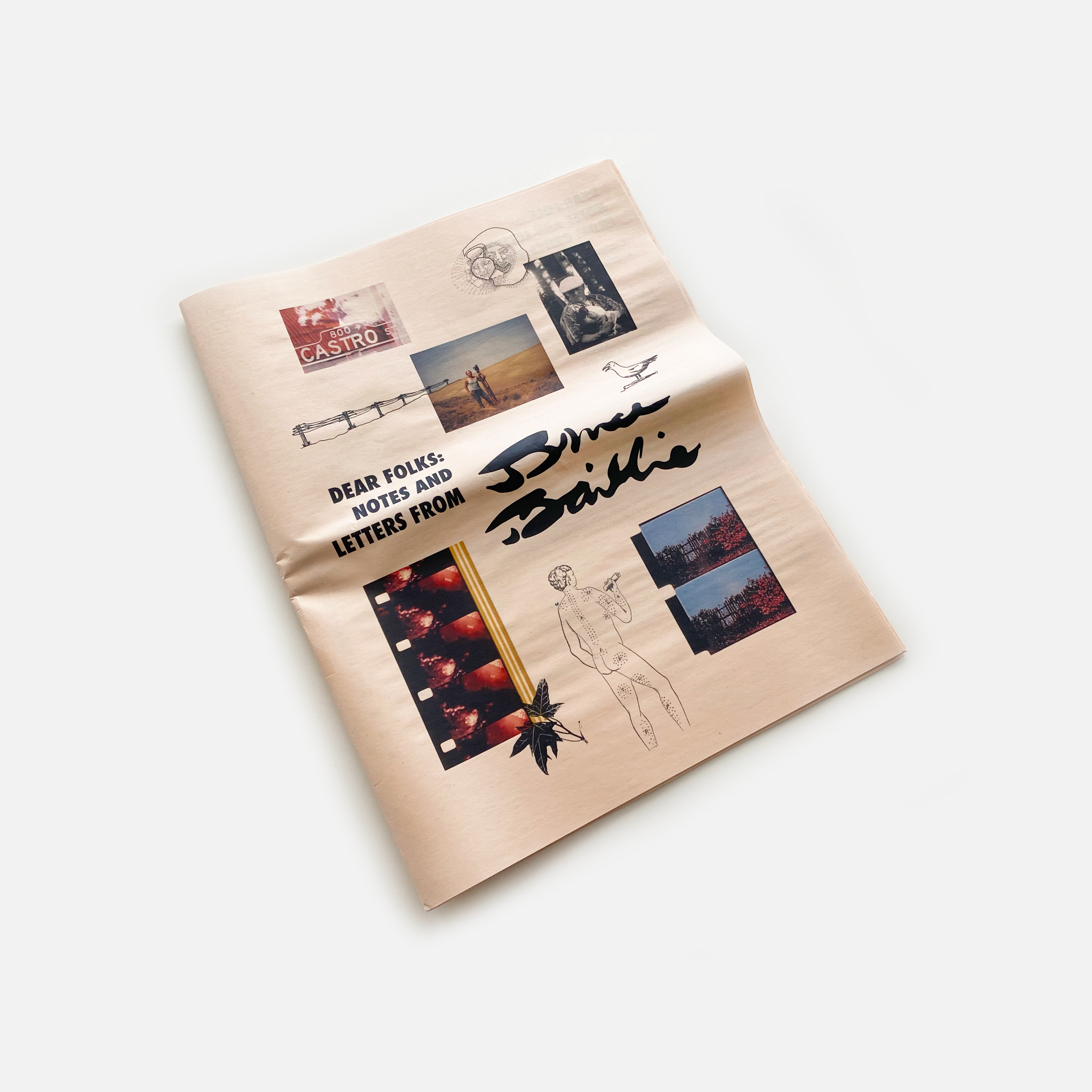
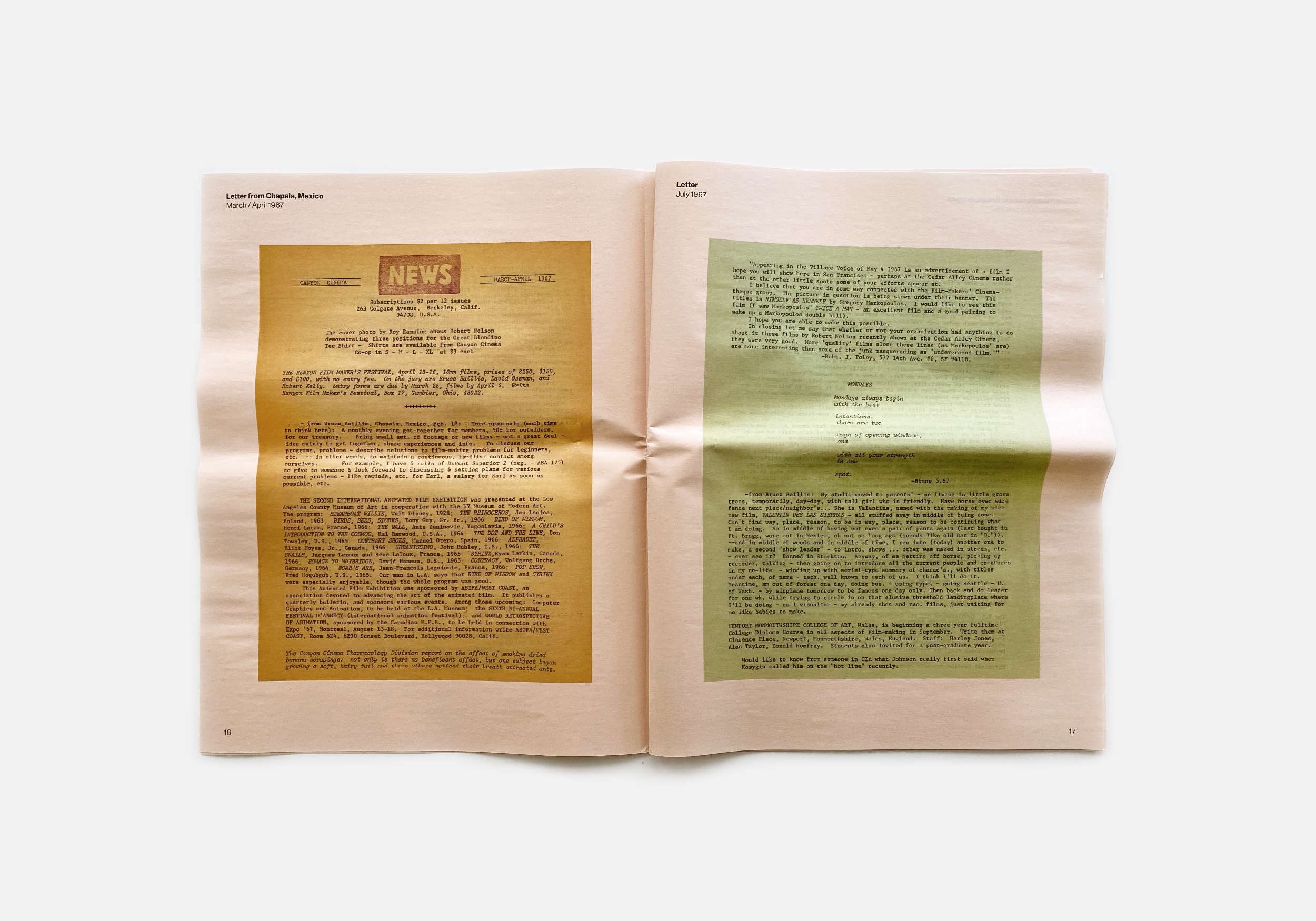
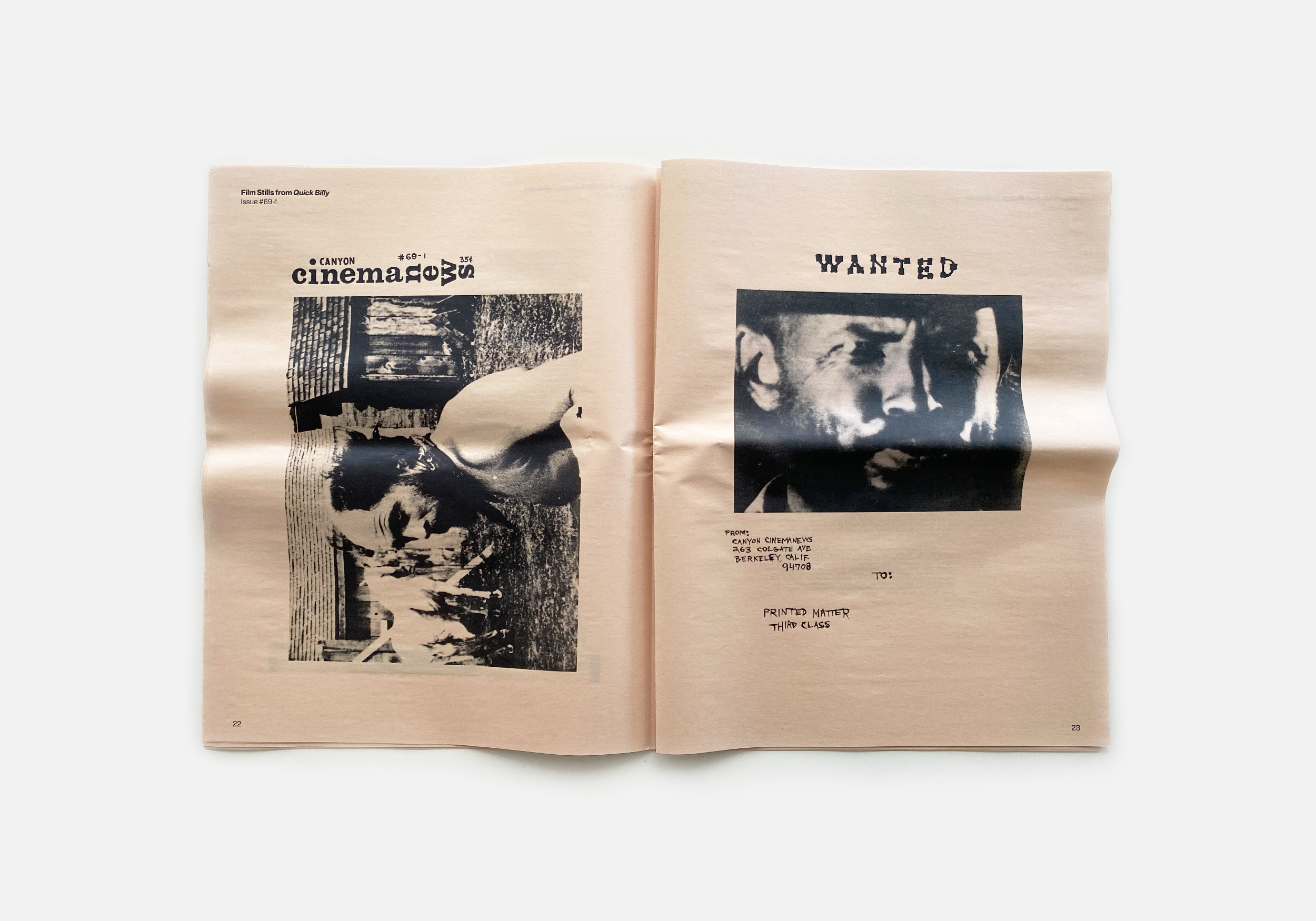
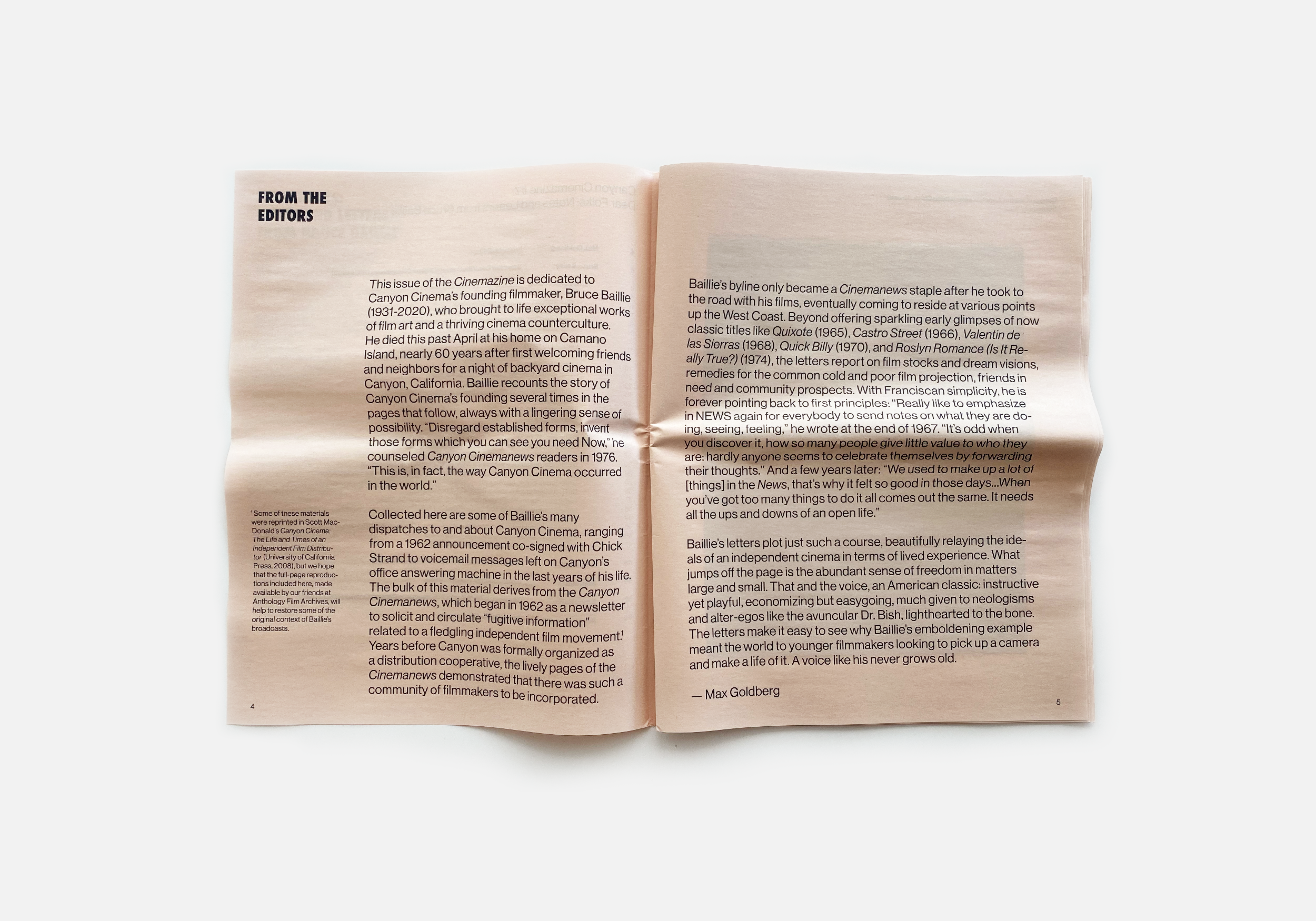
But it was the work of Bruce Baillie that most moved me and initially influenced my films. When I learned that he would be teaching filmmaking at the Mendocino Art Center in the summer of 1968, I was thrilled. Along with a high school crush and budding painter, Alex, I spent that summer enthralled by Baillie, the man and his methods, and I was the class’s most passionate student. Baillie was filming Quick Billy, and I was proud to be asked to be camera for scenes in which he appeared. Alex was an early character in my own first films, my art fueled by erotic sublimation.
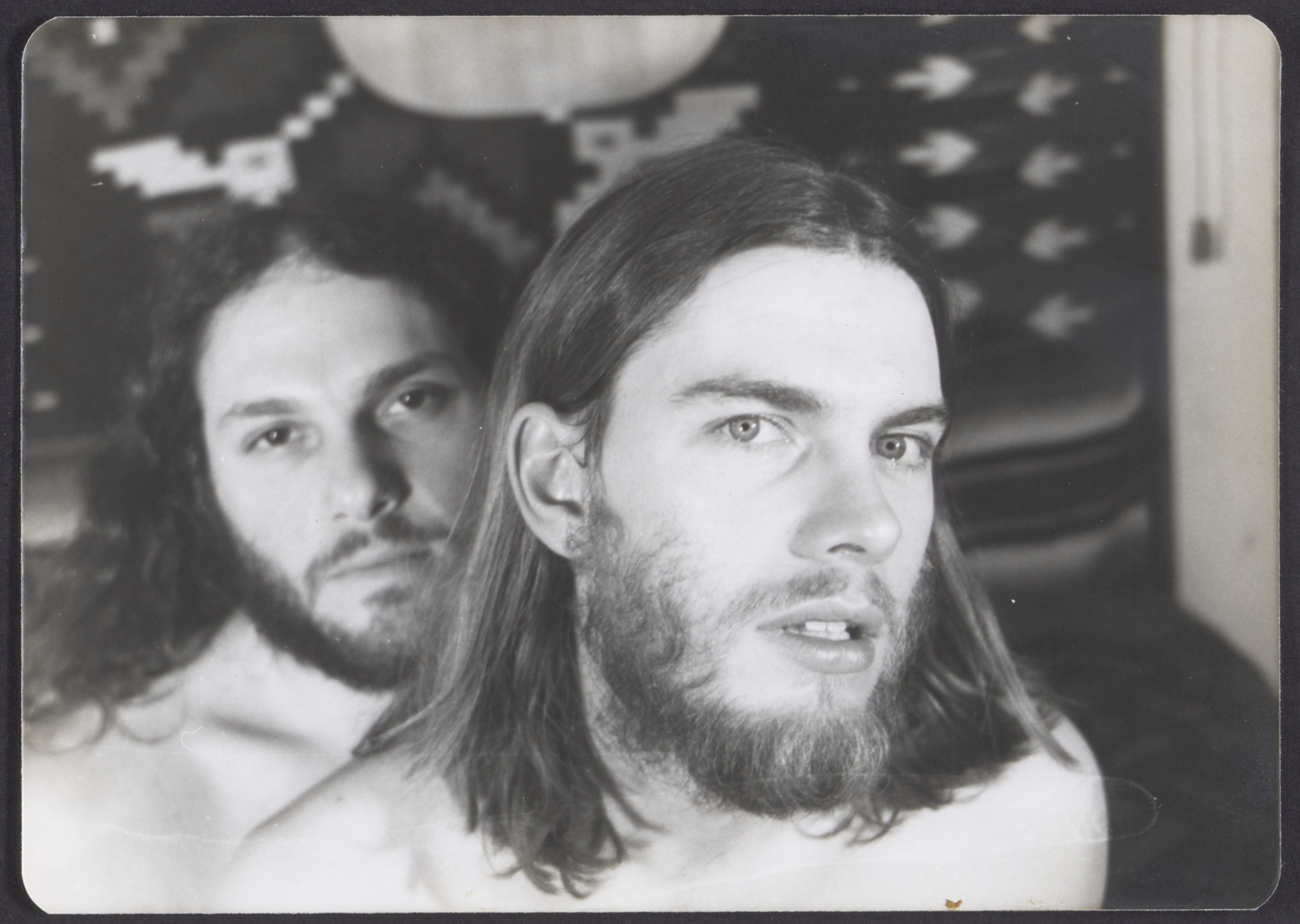
I was an undergrad at UC Berkeley in 1969 when, shortly after the Stonewall riots, I came out, along with thousands in the Bay Area. The closets suddenly seemed empty. When I arrived at San Francisco State, I had little on my mind except film and sex, and it seemed natural to bring the two together. My exposure to personal experimental film at Yale suggested the importance of individual expression on film in an honest and open fashion. One’s intimate life could be the subject of one’s art, and what is more intimate than sex?
Up to this time (to these eyes, in any case), there had been little on the screen of homoerotic interest. Two notable exceptions that I had seen while in high school were made nearly a quarter century earlier: Kenneth Anger’s Fireworks (1947) and Jean Genet’s Un Chant d’Amour (1950). I found both films profoundly erotic and disturbing, and both strongly influenced The Place Between Our Bodies, my 1975 thesis film. This became a marker of sorts, being described as the first gay (“queer” hadn’t emerged as the term of choice) film to portray explicit sex/lovemaking—Mark, my lover, and I were sensitively filmed by my straight friend, Lenny Levy—without being pornographic. The Place was not designed to be a solely voyeuristic experience, its purpose simply to titillate, to provide masturbatory fodder; the film had heart, soul, and wonder at its core. At its premiere screening at S.F. State in which grads presented their thesis films, it was met with shock, silence, and kudos. I was proud and terrified, and was congratulated on my courage. The film is raw and confessional and traverses my own sexual odyssey: desire, fantasy, cruising/anonymous sex, and falling in love.
I was proud of my sexuality and, being a rebel and a hippie, perfectly happy to flaunt it. From the time I came out until I met Mark in 1973, my sex life had mostly been a series of one-night stands, a period fueled by fantasy, desire, and a sort of benign sexual addiction. I had also fallen in love with Sam, who was in a relationship: we met secretly to see each other and kiss passionately, but the lure of the unattainable was powerful. All of these erotic phenomena became the subject matter of The Place Between Our Bodies. The initial scenes, shot wandering the streets, suggest a furtive, charged, yet slightly desperate search for an erotic connection. We see many guys in their late teens or early twenties lounging around suggestively or going about their lives, the camera catching faces and gestures. These men, unaware of being filmed, have a physical and emotional distance, suggesting my own struggle with making a real connection and the primacy of fantasy and projection in the sexual hunt. A quick 8mm shot of Alex finds its way into the film; Sam plays himself in an Anger-like fantasy sequence; Mark becomes the focus in the final third, embodying the romantic/erotic ideal, a being in whom I could invest all of my love and sexual energy. The scenes of lovemaking seem almost too leisurely, as the film luxuriates in the tenderness and intensity of the sex act.
These were heady and exciting times for queers of all persuasions. For those making films, the period provided ready-made subject matter: ourselves and the new movement of “gay liberation.” Another student at SF State was Barbara Hammer, who was just starting to produce lesbian-themed films. We became the “odd couple” of queer film, although she soon far outpaced me in terms of output. I was the Bruce Baillie, she the Stan Brakhage of this niche of experimental film. Her early Dyketactics (1974), Women I Love (1976), and Multiple Orgasm (1977) were groundbreaking statements. They not only portrayed women loving women, but women as sensual and sexual beings, a notion that was still a rarity on-screen. Though less plentiful than their male counterparts, other lesbian filmmakers were making explicit work, such as Constance Beeson, with her lyrical, bucolic film Holding (1971).
Interestingly, aside from supporting one another’s work, there was not a lot of cross-pollination between the worlds of experimental gay male and lesbian film. I respected and encouraged Barbara, and she me, but we didn’t become involved in any creative collaboration. The cross-pollination that did occur happened socially: we were part of a network of queer, straight (sexually, that is), and questioning (today’s term) experimental artists and hippies, bound less by sexual orientation than our taste in drugs and music. We celebrated our countercultural roots at parties, screenings, bars, and clubs. This was the period of women’s liberation as well, and lesbians were at the vanguard (many young women were “choosing” to become lesbians!). Women in general didn’t want to have a lot to do with men, gay or not. So it wasn’t a cohesive scene; rather, the movements developed in parallel. There was the notion that men couldn’t begin to understand female sexuality, and vice versa.
San Francisco State was hardly a hotbed of queer activity; however, Barbara and I were seen as rebels and innovators, stirring up the shit in an otherwise precious atmosphere. The French cineastes, signs versus symbols: semiotics was the film theory du jour. I, being more of an auteurist, found myself on the outs. Semiotics seemed too cerebral, too intellectually pristine. The auteur stance was about the artist, and how his or her stylistic “stamp” marked each film. This made sense to me, a nascent film artist trying to stake out territory in a crowded field. My films would reflect me: the queer me, the sexual me, the tender me, the tortured (!) me, the ecstatic me. Barbara held a similar perspective. But putting female and male genitalia into the pot (never in the same pot) got us into a lot of trouble. The proposal for The Place Between Our Bodies did not allude to the X-rated sex, hence the stunned silence that greeted its premiere. You couldn’t intellectualize this stuff; it hit you in your heart (and loins).
Several important Bay Area queer filmmakers were working in the early 1970s. Curt McDowell was at the San Francisco Art Institute across town. Curt, who died tragically of AIDS in 1987, was one of a kind. His films combined vaudeville, hard-core sex, and personal revelation. Confessions (1971) was a coming-out letter to his parents and the world, a detailing of his sexual escapades. Ronnie (1972) was a crude (but loving) exposé of a male hustler, ending (appropriately) with a hand job. Nudes (A Sketchbook) (1975) was a pansexual series of self-contained vignettes portraying the (mostly sexual) quirks of his friends, both male and female. Curt might have been the first truly “queer” experimental filmmaker; he certainly would have embraced the term.
Curt was unique in this respect: resisting categorization as gay or bi, he was perhaps the first of this generation of filmmakers who celebrated sex itself, without taking a stand or proselytizing. For Curt, sex was another element of being completely alive. In ways he was a sexual “naif,” eavesdropping on the many ways both men and women could sensually and sexually use their bodies and enjoy themselves. A preeminent voyeur, his last important work, Loads (1980), unabashedly explored a fetish of his own, which in another era would have been “rough trade.” The film chronicles encounters (though Curt is a minor character, being behind the camera) with (mostly) hairy, muscled, tattooed, and, importantly, straight men, each episode ending in the act that lends the film its title. In an era of gay liberation, this could be construed as internalized homophobia and self-hatred, but Curt stood outside politics.
There were, as well, representatives of the earlier generation of experimental filmmakers whose work embodied a queer sensibility. Primary in the Bay Area was James Broughton, whose playful, life-affirming, androgynous films took a sexual turn in the seventies, undoubtedly due to gay liberation. Broughton was a teacher of mine at SF State and an important influence, more on my life than on my films. I took his class Visionary Film (which he also taught at the Art Institute). I found his own films a bit silly and precious, but his taste was impeccable; the course was a sort of encyclopedic history of experimental cinema, featuring many seminal works I had not seen. The most potent for me was Christopher Maclaine’s The End (1953). The film (while having little to do with sexuality per se) dealt with the ways human beings make connections and yet how intensely alone each of us really is.
Broughton was all about connection: a sensualist who brought his notions of physicality and the polymorphously perverse into his classroom, behavior that today would result in being fired and ostracized. Broughton had his hands all over his students (or at least those, such as this writer, he found attractive and sensed wouldn’t reject his overtures), but never inappropriately. He was simply happy being in physical contact with other men. He represented something missing from the rest of the scene at SF State, a lightness and frivolity that was a refreshing break from semiotics.
San Francisco State and the San Francisco Art Institute were a study in contrasts, the former rule-bound and academic, and the latter lawless, with an anything-goes attitude. Broughton became lovers with a student at the Art Institute, Joel Singer, another situation that today wouldn’t be tolerated. They collaborated on films such as Song of the Godbody (1977), which featured extreme close-ups of Broughton’s nude body; Hermes Bird (1979), perhaps the ultimate ode to the phallus, Joel’s that is; and Devotions (1983), portraits of male couples. For James, Joel was a paragon of masculine beauty and a muse for his later work. Joel was more a minimalist/structuralist in his work and brought cinematic discipline to their collaborations. In films such as The Gardener of Eden (1981), filmed in Sri Lanka and celebrating the lushness of the tropical landscape (and the beauty of its young men), Joel’s controlled camera and editing worked beautifully with Broughton’s rich sensuousness. The film is lushly green, reflecting the tropics; out of the trees and foliage comes a succession beautiful, dark, somewhat androgynous young men. They throb almost psychedelically and seem to invite us into their innocent, primal world where pleasures of the flesh can be indulged without guilt or shame.
George Kuchar, who had been working in the Bronx, moved to San Francisco in the early 1970s and also taught at the Art Institute. With his unique artistic sensibility, George was another one of a kind, a sort of child-man. Sometimes I questioned whether this was an act, a crafted persona, but George was George and never less than genuine. Influence and collaboration were important factors in the nascent queer film scene. George and Curt McDowell became lovers for a time. George had always been more circumspect in his portrayal of sex, but with Curt produced what came to be another milestone, Thundercrack (1975). The film was an outrageous two-hour feature that combined the camp parody of Kuchar with the sexually explicit gay/straight/bi couplings of McDowell, starring the inimitable Marion Eaton (and her versatile cucumber). I remember early screenings of Thundercrack (at the Roxie Cinema and Canyon Cinematheque) as wild, untamed explosions of hilarity and outrageous carrying on, where all of us hippie, queer artists came together to celebrate our audacious “fuck you” attitude toward the uptight “straights” (as in conventional). No one cared about sexual orientation, so long as you flaunted it. These screenings were like parties: there was no separation between the filmmakers, cast, and audience. The artists simply gave voice to the Zeitgeist; we were in this together. As the couplings on-screen became steamier, the audience became more raucous, shouting at the screen, egging the characters on, as if watching some live improvisational happening.
Like most vibrant fringe artistic scenes, queer experimental cinema became more mainstream, if not exactly co-opted (since queer sex could never be shown at the neighborhood multiplex, much less on PBS). This happened with the advent of the San Francisco International Lesbian & Gay Film Festival, which made its first humble appearance in 1977, screening Super 8 films in a small auditorium to a select few. The slightly larger 1978 version was the first of many festival screenings for The Place Between Our Bodies. Yet these events were still underground affairs; the press was minimal, and you learned about the screenings through the gay papers (B.A.R., The Sentinel), flyers on telephone poles in the Castro and South of Market, and by word of mouth. My recollections of these and other early gay screenings are vague (keeping in mind the maxim “If you remember those days vividly you probably weren’t there”!). However, I was pleased that my film had been chosen for this seminal event: I felt vindicated in my new identity as “gay filmmaker.” As well, an entire artistic movement and powerful sexual minority had finally been given legitimacy and a voice.
Yet, in a few years, the Lesbian & Gay Film Festival evolved, with a different audience and purpose in mind. Even if the agenda was not precisely political, the goal was to broaden exposure to the general public of gay and lesbian film, that public being, of course, other gay men and lesbians. These were people for whom sexual orientation was a central part of their identity, but in a different way than for the disenfranchised queers flocking to Thundercrack. The Stonewall rebellion was almost a decade old, and the boys in their teens and men in their twenties who came out then were settling happily into their gay identity, wearing it like a badge. These were mostly mainstream, “straight” gay men who spent their time at bars in the Castro dancing to disco and then meeting at the South of Market bathhouses. Somehow, we offbeat gay boys disdained this scene, preferring to congregate at the Stud (the original on Folsom Street), or at the crazy diner Hamburger Mary’s, which had an amazing collection of flea-market kitsch hanging from the ceiling and walls.
But I’m getting ahead of myself. The San Francisco alternative gay scene was already flourishing in the early seventies. It gathered steam and gained notoriety with the appearance of the in-your-face bearded drag troupe the Cockettes; the playful, anti-religious collection of (again bearded) nuns, the Sisters of Perpetual Indulgence; and finally, the outrageous films of John Waters, starring the one-of-a-kind creature Divine. I vividly remember being at the Stud and going home with a beautiful long-haired blond named David. Waking up at his place, we walked into the kitchen and there was his roommate, Divine (sans big hair).
Ironically, it was shortly after The Place that I completely departed from sex or queer identity as subject matter. Somehow, for me, the energy had dissipated and become darker. Perhaps this was reflected by the shift in the drug scene, from marijuana and psychedelics to cocaine, speed, and heroin. I finally returned to exploring queer identity in my work with the film Decodings (1988) over a decade later. This was a backward look, through the lens of found footage—documentaries, newsreels, instructional films—at growing up male and gay in the 1950s and sixties. The film reflected the alienation from one’s sexuality given the sociocultural repression of the period. This hauntingly paralleled the renewed repression of the 1980s, in which sex almost retreated into the closet with the AIDS epidemic. Decodings portrays desperate attempts to make physical and emotional connections with other males (if only through the discipline of the military or contact sports) to loosen the suffocating self-constraint of rigid social controls. The narration is dark and ironic: our un-hero only gets relief by driving into the eye of a massive storm. But poignancy triumphs: “A heart is laid bare.”
In 1995 my preoccupations came full circle with Black Sheep Boy, perhaps a more mature, restrained version of The Place that addressed many of the same issues. Here I was, twenty years older, again pondering the timeless questions of longing, desire, and human connection. The film seems less celebratory than nostalgic and sad, yet no less obsessed with its subject. Again I examine that double-edged sword, the allure of youth. Yet here I am more the detached observer than the involved participant. The camera more carefully explores its subject: a series of young men, this time aware of being filmed, not quite acting but appropriately (by degrees) awkward and self-conscious. They are both themselves and a composite projection of what I want them to be, shaped by the caress of the camera. The narration of tales and allegories, some fantastic, some gritty, are united by their sexual charge and (again) desperate need to connect, perhaps with my younger self. It is bracketed by the story of a twelve-year-old waif wandering bleak underground tunnels clutching dying flowers. Black Sheep Boy is not about being queer, but neither, really, was The Place about being gay. They are both personal testaments that deal with sexuality, one from the vantage of a twenty-five-year-old, the other from that of a forty-five-year-old. One could say that Black Sheep Boy represents the more measured, internalized self I seem to have become. Still, the more things change . . .
As a filmmaker and artist, I came of age with the movement. In retrospect, my coming out in 1969 seemed representative of a certain generation of gay men. We were too young to have inhabited the closets for long, yet enjoyed twelve liberating, mostly joyous years before AIDS made its tragic appearance. The newer generation of gay men would never be able to separate sex and death. As someone who has experienced both sides of this sexual trajectory (the early open brashness followed suddenly by the scary consequences of that hedonism), I’ve grown older with the movement as well. It’s been an exhilarating and sometimes horrifying ride, and has certainly provided a complex perspective to the role sex plays in my life and my relationships.
This sobering thought brings me, circuitously, to my final point: Are we experimental filmmakers who sometimes make queer films? Or are we queer filmmakers who make queer films, whatever the subject? Or is this one of those academic conundrums it is futile to attempt to resolve? In Amsterdam, that queerest of cities, there is no Lesbian & Gay Film Festival. Perhaps that’s as good an answer as we’ll get.