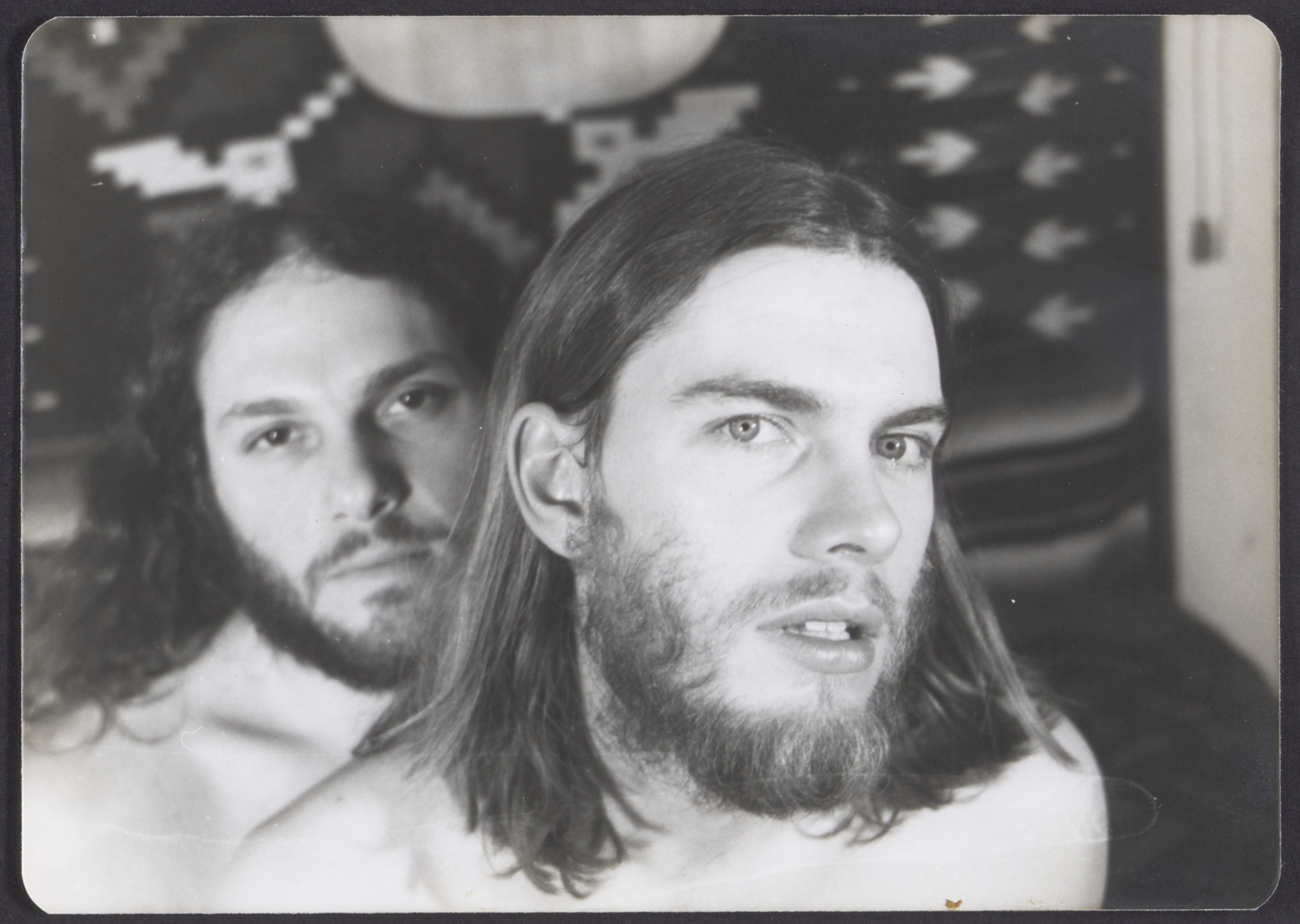
Production still for The Place Between Our Bodies (1975), Michael Wallin on left
By Michael Wallin
This essay originally appeared in Steve Anker, Kathy Geritz, and Steve Seid, eds., Radical Light: Alternative Film & Video in the San Francisco Bay Area, 1945-2000 (Berkeley: University of California Press, 2010), 196-201. Republished with the permission of the Estate of Michael Wallin.
In 1971 I began graduate film school at San Francisco State University. My undergraduate major had been psychology, but at Yale and UC Berkeley I had been exposed to a huge range of experimental film, everything from Stan Brakhage and Bruce Baillie (the lyrical end) to Michael Snow and Paul Sharits (the structural end), with side trips to Andy Warhol and Kenneth Anger. The latter two, with their frank, intense, yet matter-of-fact portrayal of queer sexuality, were revelations. One didn’t hold back one’s feelings regarding this renegade art form, as was made abundantly clear at two Yale screenings I remember vividly. At one, a segment of the audience couldn’t tolerate the lack of sound in Brakhage’s work, and actually threw overripe tomatoes at the screen. At another, word that the Japanese avant-garde maker Takahiko limura would show his sexually explicit films spread so that an enormous mob appeared, and the crush of horny, agitated (male) students led to the New Haven police being called to prevent a riot.
But it was the work of Bruce Baillie that most moved me and initially influenced my films. When I learned that he would be teaching filmmaking at the Mendocino Art Center in the summer of 1968, I was thrilled. Along with a high school crush and budding painter, Alex, I spent that summer enthralled by Baillie, the man and his methods, and I was the class’s most passionate student. Baillie was filming Quick Billy, and I was proud to be asked to be camera for scenes in which he appeared. Alex was an early character in my own first films, my art fueled by erotic sublimation.
I was an undergrad at UC Berkeley in 1969 when, shortly after the Stonewall riots, I came out, along with thousands in the Bay Area. The closets suddenly seemed empty. When I arrived at San Francisco State, I had little on my mind except film and sex, and it seemed natural to bring the two together. My exposure to personal experimental film at Yale suggested the importance of individual expression on film in an honest and open fashion. One’s intimate life could be the subject of one’s art, and what is more intimate than sex?
Up to this time (to these eyes, in any case), there had been little on the screen of homoerotic interest. Two notable exceptions that I had seen while in high school were made nearly a quarter century earlier: Kenneth Anger’s Fireworks (1947) and Jean Genet’s Un Chant d’Amour (1950). I found both films profoundly erotic and disturbing, and both strongly influenced The Place Between Our Bodies, my 1975 thesis film. This became a marker of sorts, being described as the first gay (“queer” hadn’t emerged as the term of choice) film to portray explicit sex/lovemaking—Mark, my lover, and I were sensitively filmed by my straight friend, Lenny Levy—without being pornographic. The Place was not designed to be a solely voyeuristic experience, its purpose simply to titillate, to provide masturbatory fodder; the film had heart, soul, and wonder at its core. At its premiere screening at S.F. State in which grads presented their thesis films, it was met with shock, silence, and kudos. I was proud and terrified, and was congratulated on my courage. The film is raw and confessional and traverses my own sexual odyssey: desire, fantasy, cruising/anonymous sex, and falling in love.
I was proud of my sexuality and, being a rebel and a hippie, perfectly happy to flaunt it. From the time I came out until I met Mark in 1973, my sex life had mostly been a series of one-night stands, a period fueled by fantasy, desire, and a sort of benign sexual addiction. I had also fallen in love with Sam, who was in a relationship: we met secretly to see each other and kiss passionately, but the lure of the unattainable was powerful. All of these erotic phenomena became the subject matter of The Place Between Our Bodies. The initial scenes, shot wandering the streets, suggest a furtive, charged, yet slightly desperate search for an erotic connection. We see many guys in their late teens or early twenties lounging around suggestively or going about their lives, the camera catching faces and gestures. These men, unaware of being filmed, have a physical and emotional distance, suggesting my own struggle with making a real connection and the primacy of fantasy and projection in the sexual hunt. A quick 8mm shot of Alex finds its way into the film; Sam plays himself in an Anger-like fantasy sequence; Mark becomes the focus in the final third, embodying the romantic/erotic ideal, a being in whom I could invest all of my love and sexual energy. The scenes of lovemaking seem almost too leisurely, as the film luxuriates in the tenderness and intensity of the sex act.
These were heady and exciting times for queers of all persuasions. For those making films, the period provided ready-made subject matter: ourselves and the new movement of “gay liberation.” Another student at SF State was Barbara Hammer, who was just starting to produce lesbian-themed films. We became the “odd couple” of queer film, although she soon far outpaced me in terms of output. I was the Bruce Baillie, she the Stan Brakhage of this niche of experimental film. Her early Dyketactics (1974), Women I Love (1976), and Multiple Orgasm (1977) were groundbreaking statements. They not only portrayed women loving women, but women as sensual and sexual beings, a notion that was still a rarity on-screen. Though less plentiful than their male counterparts, other lesbian filmmakers were making explicit work, such as Constance Beeson, with her lyrical, bucolic film Holding (1971).
Interestingly, aside from supporting one another’s work, there was not a lot of cross-pollination between the worlds of experimental gay male and lesbian film. I respected and encouraged Barbara, and she me, but we didn’t become involved in any creative collaboration. The cross-pollination that did occur happened socially: we were part of a network of queer, straight (sexually, that is), and questioning (today’s term) experimental artists and hippies, bound less by sexual orientation than our taste in drugs and music. We celebrated our countercultural roots at parties, screenings, bars, and clubs. This was the period of women’s liberation as well, and lesbians were at the vanguard (many young women were “choosing” to become lesbians!). Women in general didn’t want to have a lot to do with men, gay or not. So it wasn’t a cohesive scene; rather, the movements developed in parallel. There was the notion that men couldn’t begin to understand female sexuality, and vice versa.
San Francisco State was hardly a hotbed of queer activity; however, Barbara and I were seen as rebels and innovators, stirring up the shit in an otherwise precious atmosphere. The French cineastes, signs versus symbols: semiotics was the film theory du jour. I, being more of an auteurist, found myself on the outs. Semiotics seemed too cerebral, too intellectually pristine. The auteur stance was about the artist, and how his or her stylistic “stamp” marked each film. This made sense to me, a nascent film artist trying to stake out territory in a crowded field. My films would reflect me: the queer me, the sexual me, the tender me, the tortured (!) me, the ecstatic me. Barbara held a similar perspective. But putting female and male genitalia into the pot (never in the same pot) got us into a lot of trouble. The proposal for The Place Between Our Bodies did not allude to the X-rated sex, hence the stunned silence that greeted its premiere. You couldn’t intellectualize this stuff; it hit you in your heart (and loins).
Several important Bay Area queer filmmakers were working in the early 1970s. Curt McDowell was at the San Francisco Art Institute across town. Curt, who died tragically of AIDS in 1987, was one of a kind. His films combined vaudeville, hard-core sex, and personal revelation. Confessions (1971) was a coming-out letter to his parents and the world, a detailing of his sexual escapades. Ronnie (1972) was a crude (but loving) exposé of a male hustler, ending (appropriately) with a hand job. Nudes (A Sketchbook) (1975) was a pansexual series of self-contained vignettes portraying the (mostly sexual) quirks of his friends, both male and female. Curt might have been the first truly “queer” experimental filmmaker; he certainly would have embraced the term.
Curt was unique in this respect: resisting categorization as gay or bi, he was perhaps the first of this generation of filmmakers who celebrated sex itself, without taking a stand or proselytizing. For Curt, sex was another element of being completely alive. In ways he was a sexual “naif,” eavesdropping on the many ways both men and women could sensually and sexually use their bodies and enjoy themselves. A preeminent voyeur, his last important work, Loads (1980), unabashedly explored a fetish of his own, which in another era would have been “rough trade.” The film chronicles encounters (though Curt is a minor character, being behind the camera) with (mostly) hairy, muscled, tattooed, and, importantly, straight men, each episode ending in the act that lends the film its title. In an era of gay liberation, this could be construed as internalized homophobia and self-hatred, but Curt stood outside politics.
There were, as well, representatives of the earlier generation of experimental filmmakers whose work embodied a queer sensibility. Primary in the Bay Area was James Broughton, whose playful, life-affirming, androgynous films took a sexual turn in the seventies, undoubtedly due to gay liberation. Broughton was a teacher of mine at SF State and an important influence, more on my life than on my films. I took his class Visionary Film (which he also taught at the Art Institute). I found his own films a bit silly and precious, but his taste was impeccable; the course was a sort of encyclopedic history of experimental cinema, featuring many seminal works I had not seen. The most potent for me was Christopher Maclaine’s The End (1953). The film (while having little to do with sexuality per se) dealt with the ways human beings make connections and yet how intensely alone each of us really is.
Broughton was all about connection: a sensualist who brought his notions of physicality and the polymorphously perverse into his classroom, behavior that today would result in being fired and ostracized. Broughton had his hands all over his students (or at least those, such as this writer, he found attractive and sensed wouldn’t reject his overtures), but never inappropriately. He was simply happy being in physical contact with other men. He represented something missing from the rest of the scene at SF State, a lightness and frivolity that was a refreshing break from semiotics.
San Francisco State and the San Francisco Art Institute were a study in contrasts, the former rule-bound and academic, and the latter lawless, with an anything-goes attitude. Broughton became lovers with a student at the Art Institute, Joel Singer, another situation that today wouldn’t be tolerated. They collaborated on films such as Song of the Godbody (1977), which featured extreme close-ups of Broughton’s nude body; Hermes Bird (1979), perhaps the ultimate ode to the phallus, Joel’s that is; and Devotions (1983), portraits of male couples. For James, Joel was a paragon of masculine beauty and a muse for his later work. Joel was more a minimalist/structuralist in his work and brought cinematic discipline to their collaborations. In films such as The Gardener of Eden (1981), filmed in Sri Lanka and celebrating the lushness of the tropical landscape (and the beauty of its young men), Joel’s controlled camera and editing worked beautifully with Broughton’s rich sensuousness. The film is lushly green, reflecting the tropics; out of the trees and foliage comes a succession beautiful, dark, somewhat androgynous young men. They throb almost psychedelically and seem to invite us into their innocent, primal world where pleasures of the flesh can be indulged without guilt or shame.
George Kuchar, who had been working in the Bronx, moved to San Francisco in the early 1970s and also taught at the Art Institute. With his unique artistic sensibility, George was another one of a kind, a sort of child-man. Sometimes I questioned whether this was an act, a crafted persona, but George was George and never less than genuine. Influence and collaboration were important factors in the nascent queer film scene. George and Curt McDowell became lovers for a time. George had always been more circumspect in his portrayal of sex, but with Curt produced what came to be another milestone, Thundercrack (1975). The film was an outrageous two-hour feature that combined the camp parody of Kuchar with the sexually explicit gay/straight/bi couplings of McDowell, starring the inimitable Marion Eaton (and her versatile cucumber). I remember early screenings of Thundercrack (at the Roxie Cinema and Canyon Cinematheque) as wild, untamed explosions of hilarity and outrageous carrying on, where all of us hippie, queer artists came together to celebrate our audacious “fuck you” attitude toward the uptight “straights” (as in conventional). No one cared about sexual orientation, so long as you flaunted it. These screenings were like parties: there was no separation between the filmmakers, cast, and audience. The artists simply gave voice to the Zeitgeist; we were in this together. As the couplings on-screen became steamier, the audience became more raucous, shouting at the screen, egging the characters on, as if watching some live improvisational happening.
Like most vibrant fringe artistic scenes, queer experimental cinema became more mainstream, if not exactly co-opted (since queer sex could never be shown at the neighborhood multiplex, much less on PBS). This happened with the advent of the San Francisco International Lesbian & Gay Film Festival, which made its first humble appearance in 1977, screening Super 8 films in a small auditorium to a select few. The slightly larger 1978 version was the first of many festival screenings for The Place Between Our Bodies. Yet these events were still underground affairs; the press was minimal, and you learned about the screenings through the gay papers (B.A.R., The Sentinel), flyers on telephone poles in the Castro and South of Market, and by word of mouth. My recollections of these and other early gay screenings are vague (keeping in mind the maxim “If you remember those days vividly you probably weren’t there”!). However, I was pleased that my film had been chosen for this seminal event: I felt vindicated in my new identity as “gay filmmaker.” As well, an entire artistic movement and powerful sexual minority had finally been given legitimacy and a voice.
Yet, in a few years, the Lesbian & Gay Film Festival evolved, with a different audience and purpose in mind. Even if the agenda was not precisely political, the goal was to broaden exposure to the general public of gay and lesbian film, that public being, of course, other gay men and lesbians. These were people for whom sexual orientation was a central part of their identity, but in a different way than for the disenfranchised queers flocking to Thundercrack. The Stonewall rebellion was almost a decade old, and the boys in their teens and men in their twenties who came out then were settling happily into their gay identity, wearing it like a badge. These were mostly mainstream, “straight” gay men who spent their time at bars in the Castro dancing to disco and then meeting at the South of Market bathhouses. Somehow, we offbeat gay boys disdained this scene, preferring to congregate at the Stud (the original on Folsom Street), or at the crazy diner Hamburger Mary’s, which had an amazing collection of flea-market kitsch hanging from the ceiling and walls.
But I’m getting ahead of myself. The San Francisco alternative gay scene was already flourishing in the early seventies. It gathered steam and gained notoriety with the appearance of the in-your-face bearded drag troupe the Cockettes; the playful, anti-religious collection of (again bearded) nuns, the Sisters of Perpetual Indulgence; and finally, the outrageous films of John Waters, starring the one-of-a-kind creature Divine. I vividly remember being at the Stud and going home with a beautiful long-haired blond named David. Waking up at his place, we walked into the kitchen and there was his roommate, Divine (sans big hair).
Ironically, it was shortly after The Place that I completely departed from sex or queer identity as subject matter. Somehow, for me, the energy had dissipated and become darker. Perhaps this was reflected by the shift in the drug scene, from marijuana and psychedelics to cocaine, speed, and heroin. I finally returned to exploring queer identity in my work with the film Decodings (1988) over a decade later. This was a backward look, through the lens of found footage—documentaries, newsreels, instructional films—at growing up male and gay in the 1950s and sixties. The film reflected the alienation from one’s sexuality given the sociocultural repression of the period. This hauntingly paralleled the renewed repression of the 1980s, in which sex almost retreated into the closet with the AIDS epidemic. Decodings portrays desperate attempts to make physical and emotional connections with other males (if only through the discipline of the military or contact sports) to loosen the suffocating self-constraint of rigid social controls. The narration is dark and ironic: our un-hero only gets relief by driving into the eye of a massive storm. But poignancy triumphs: “A heart is laid bare.”
In 1995 my preoccupations came full circle with Black Sheep Boy, perhaps a more mature, restrained version of The Place that addressed many of the same issues. Here I was, twenty years older, again pondering the timeless questions of longing, desire, and human connection. The film seems less celebratory than nostalgic and sad, yet no less obsessed with its subject. Again I examine that double-edged sword, the allure of youth. Yet here I am more the detached observer than the involved participant. The camera more carefully explores its subject: a series of young men, this time aware of being filmed, not quite acting but appropriately (by degrees) awkward and self-conscious. They are both themselves and a composite projection of what I want them to be, shaped by the caress of the camera. The narration of tales and allegories, some fantastic, some gritty, are united by their sexual charge and (again) desperate need to connect, perhaps with my younger self. It is bracketed by the story of a twelve-year-old waif wandering bleak underground tunnels clutching dying flowers. Black Sheep Boy is not about being queer, but neither, really, was The Place about being gay. They are both personal testaments that deal with sexuality, one from the vantage of a twenty-five-year-old, the other from that of a forty-five-year-old. One could say that Black Sheep Boy represents the more measured, internalized self I seem to have become. Still, the more things change . . .
As a filmmaker and artist, I came of age with the movement. In retrospect, my coming out in 1969 seemed representative of a certain generation of gay men. We were too young to have inhabited the closets for long, yet enjoyed twelve liberating, mostly joyous years before AIDS made its tragic appearance. The newer generation of gay men would never be able to separate sex and death. As someone who has experienced both sides of this sexual trajectory (the early open brashness followed suddenly by the scary consequences of that hedonism), I’ve grown older with the movement as well. It’s been an exhilarating and sometimes horrifying ride, and has certainly provided a complex perspective to the role sex plays in my life and my relationships.
This sobering thought brings me, circuitously, to my final point: Are we experimental filmmakers who sometimes make queer films? Or are we queer filmmakers who make queer films, whatever the subject? Or is this one of those academic conundrums it is futile to attempt to resolve? In Amsterdam, that queerest of cities, there is no Lesbian & Gay Film Festival. Perhaps that’s as good an answer as we’ll get.