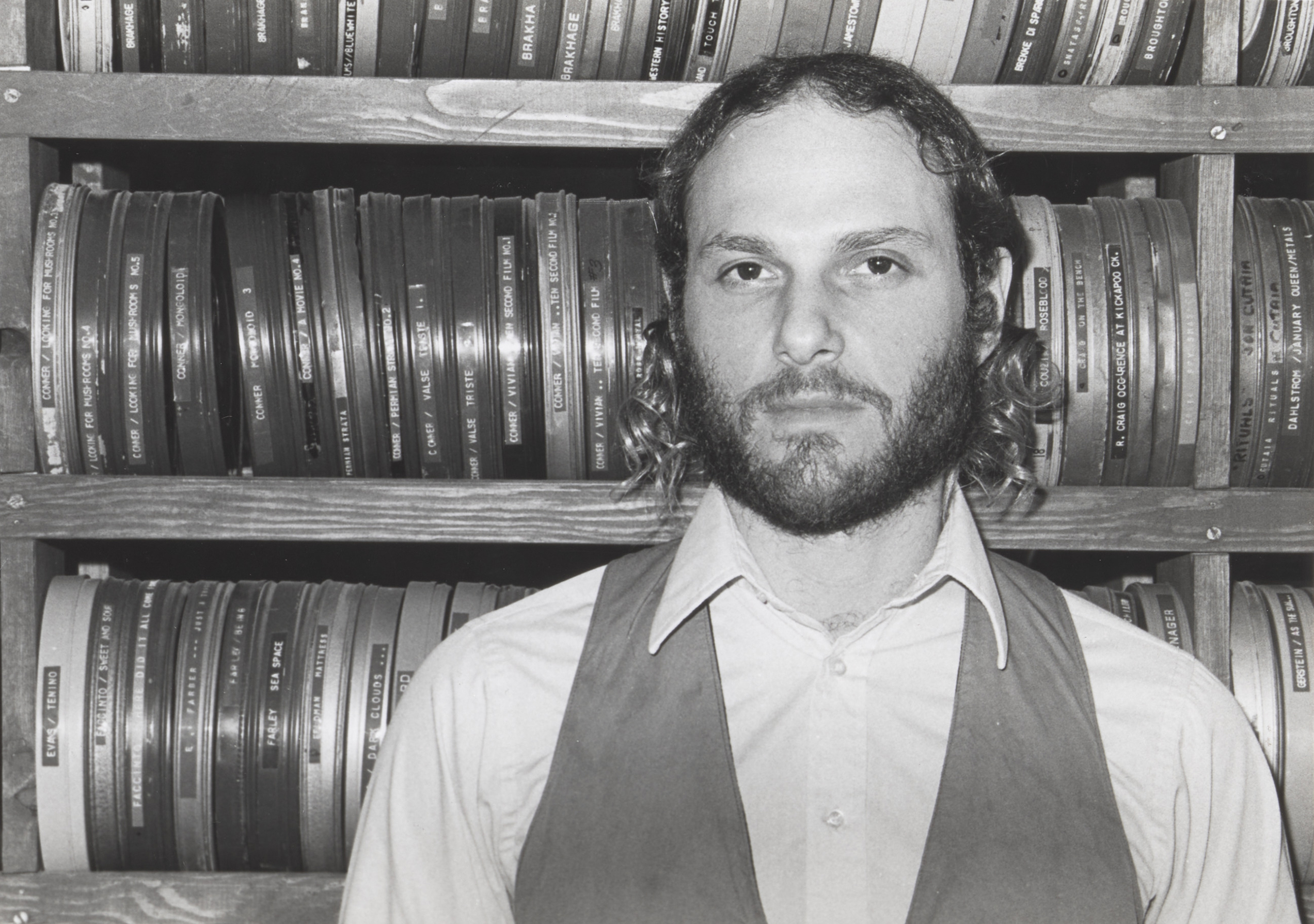
Editor’s Note: This interview was conducted as an assignment for Kathy Geritz’s Film 28B (Avant-Garde Film) class at University of California, Berkeley, circa 1997. It is published with the permission of the author.
Before I was assigned the project of interviewing a local filmmaker, I was not familiar with San Francisco filmmaker Michael Wallin or his work. Upon the suggestion of my professor, I watched Decodings, Wallin’s award-winning 1988 film. Assembled from found footage of the 1950s, and accompanied by voice-over narration, Decodings is an examination of (among other things) the issues involved with masculine maturation and friendship. After viewing the film, I was sure that I could find more than enough to talk about with this filmmaker to fill a short interview.
After a brief phone conversation, I ventured into San Francisco to meet Michael Wallin. We met, set a time for the interview, and he gave me copies of several of his other movies, as well as a variety of news clippings on his work. The tapes that he gave me covered several decades: The Place Between Our Bodies (1975), Monitoring the Unstable Earth (1980), Fearful Symmetry (1981), Along the Way (1983), and Black Sheep Boy (1995). Wallin’s films cover a variety of subjects and styles, ranging from the raw sexual imagery of The Place Between Our Bodies to the more abstract/collage material of a film like Fearful Symmetry. Watching Wallin’s films does not allow one to easily place him into any category, except perhaps for “experimental filmmaker.” That diverse, hard-to-classify quality to his work also led me to believe that Wallin would have plenty to say about any number of subjects. I was not to be disappointed on that count.
Over the course of an approximately hour-long conversation in the kitchen of his San Francisco home Wallin and I spoke about many things, including the films that I had watched, along with more general areas of his film style and background. What follows is an excerpt of our much lengthier interview.
Rain Madrone: Could you talk a little about how you got into film? Was it something that you always knew you wanted to do, or did you stumble into it?
Michael Wallin: It wasn’t something that I always knew I wanted to do. I sort of stumbled into it. I went to college at Yale as an undergraduate, and I was looking around for some courses that weren’t too academic, to balance all the academic courses, and there was a beginning film production course. So I took that, and I made my initial stabs at making films. Then at the same time, when I was at Yale, I was really lucky, because the guy who’s now considered the main theorist and writer for avant-garde cinema, P. Adams Sitney, was a graduate student when I was an undergraduate. He was head of what was called the Experimental Film Society, and he brought in from New York and all over the country experimental films that were just incredible, because I’d never really seen [films like that]. There were two instances prior to that. One was when I think I was still in high school, and there were cinemas in San Francisco that were showing experimental short films. There was one theater, I think it was in North Beach, that was showing films by Kenneth Anger. So I saw Scorpio Rising [1963] –
RM: We just watched that in class today.
MW: I was only in high school, and I loved it. It’s wonderful. The other exposure was to a film called Un chant d’amour [1950] by Jean Genet. It means “A Song of Love” in French, and it’s the only film he ever made; he’s a very famous French writer. The film had been banned because of its homoerotic content…
RM: Were you out at the time?
MW: No, I wasn’t. The film was banned, but it was rereleased during the mid-sixties, and my parents, who were very anxious that I be exposed to a lot of different cultural events, decided to take me. My brother wasn’t there for some reason. My father and I went to see this film. I don’t think he knew what he was exposing his son to at the time [laughs]. But this was an experimental film; a very potent, very powerful, very moving film, and it really shook me up. So, it was kind of like [through] those experiences at Yale, and seeing those films, and taking that course, I started getting interested [in film]. The other part of that was seeing a number of films by a filmmaker named Bruce Baillie, who’s one of the important people in the avant-garde. The summer between my sophomore and junior years in college I noticed he was teaching a course at the Mendocino Arts Center in film, so I just decided to take the course. I was sort of in awe of this man, who seemed so connected to his camera. He sort of became my mentor, so that was a turning point as well.
RM: Did you just jump right in? Was there ever a phase where it was just a hobby, or did you get interested and then it became what you did?
MW: Well, I guess you could use the word hobby, even though I still thought of it more as an art form, or art-making, when I was doing those little films at Yale. But then I made my first films that summer when I studied with Bruce. I made a couple films that are considered part of the body of my work. I made them in 8mm and then had them blown up to 16. So it was never really a hobby, exactly. When I was a kid, my family went on vacations to Europe, and I was the designated travel photographer, so I took most of our home movies. Maybe that was the beginning, the real beginning.
RM: I was also curious about the process you go through making films. Do you start with a specific idea, or are you shooting all the time, and that later turns into [a film]?
MW: Kind of both. The first films I made when I was a graduate film student at San Francisco State were definitely pre-planned. Or in other words, I started out with an idea, and then I executed the idea, allowing for a lot of improvisation and spontaneity in the filming and editing. But I definitely had an idea before. There are two films: one is called Kali’s Revue [1972], Kali being the Hindu god of [pauses] this or that, sort of a spiritual piece. The other one was called Sleepwalk [1973]. It was about what we are as humans and our gestures—I don’t want to talk a lot about that, it was too long ago. I still show that. I actually showed that a couple nights ago [laughs] at an open screening for this cinema [No Nothing Cinema] that’s dying because the San Francisco Giants ballpark is going to be built on top of it. We had some final screenings. Anyway, then there was this series of three films, which you saw, Monitoring the Unstable Earth, Fearful Symmetry, and Along the Way. [For] those films I basically just collected footage. I just carried my camera with me when I went on trips out-of-town, or sometimes I would come upon just interesting things here in San Francisco, and film them. So I gathered footage, and at a certain point I realized “oh yeah, I have a film here,” and from that point I started to edit the footage with the conception I had developed around what the film was going to be like. So, [I work] both ways. Especially now, with my last couple of films. Decodings also worked in that fashion. I didn’t really know what the film was going to be, I just started pulling interesting shots from all this found footage.
RM: I was wondering how you would classify your films. Do you see your movies as filling a particular genre?
MW: The word that’s used most frequently is experimental. For example, when you get applications to submit films for festivals, they say “narrative, documentary, experimental.” Over the last thirty years or so that I’ve been involved with this kind of filmmaking all sorts of words have been used. Avant-garde is another. You’re taking avant-garde cinema [class]. Avant-garde, experimental, visionary, underground, personal…
RM: I was going to ask you if you’ve ever wanted to work in another genre, to make a strict narrative or a documentary. But then I was thinking that a lot of these films are documentaries, just not in the conventional sense.
MW: Right, they’re experimental, personal documentaries. Was that a question?
RM: Do you have the desire to make other styles of film?
MW: Initially, when I was in film school, I kind of did. I knew I wanted to make shorter, more personal experimental films as well, but I kind of did. But I also felt like I didn’t quite have the temperament to make an independent feature film, even if it wasn’t going to be commercial. Somehow, the notion of making films that would involve many, many other people, in lots of different capacities, and having to direct all these people… all of this seemed sort of daunting to me. I generally prefer to work alone. Although now, film is one thing I do, and I have a whole other life. Now that I’ve went into this second career, I basically don’t have the time.
RM: What is that second career?
MW: Eight years ago, I went back to graduate school for a second time, in psychology. I’m finishing up now. I have the degree, and I’m finishing all the internship requirements to be a psychotherapist.
RM: Is that a “making a living” kind of choice?
MW: It came about because at the time I had been doing a number of things in film, not only the making of films, but some teaching of film, which I’m doing again now. I also ran my own company as a negative cutter, which is the last step in the process of preparing a film for printing, and which is amazingly tedious. The person I bought the company from described it to me rather romantically, saying “this is the zen of film making.” The money was okay, but it was just so tedious that I could only do that for a few years without just completely going crazy. So, basically, I was at a point where I wasn’t really getting any more teaching jobs, which I would have liked to continue getting, my films weren’t really getting shown… I’d had a lot of my work shown in group shows and some one person shows, I’d done tours with my work, but I just felt like for all the work that I was putting into the films the extent they were being shown wasn’t gratifying enough. But it mostly did have to do with making money.
RM: If you had a choice, would you just be making movies, rather than getting another career?
MW: I don’t know. I actually like doing psychotherapy a lot. I was interested in doing something that was more intellectually challenging and that was more directly involved with people.
RM: Does it fill something [in your life] that filmmaking doesn’t?
MW: Yeah, it’s sort of a nice balance. It fills these other needs that I have, and it’s gratifying in different ways. I’m not making a living at it yet. I’m doing internships, which pay nothing.
RM: Are you going to be a psychotherapist who makes films, or a filmmaker who does psychotherapy on the side?
MW: That’s a good question. My goal is to be both. I want to have a private practice, continue to teach film like I have been for the past few years, and then make films when I have the money to make them. So I would say the answer would be neither. Both.
RM: You mentioned that you like to work alone, and in a lot of the literature on Decodings they talked about how that was your first collaboration. But in almost all the other films there was another writer involved. Would you say that it’s accurate when they call Decodings your first collaboration?
MW: I do think it’s accurate.
RM: Or is it just a matter of semantics?
MW: No, it’s much more than semantics. It truly was my first real collaboration, because in the other films… Say, in Along the Way, where there are monologues, the people who spoke them wrote them and I made some alterations, but it wasn’t really like they were working with me. They were providing me with an element, like the use of music. But it wasn’t as if they were actively collaborating. So with Decodings, when I worked with Michael Blumlein, it was a real collaboration, because I gave him all this written material: dreams, fantasies, characters, ideas, around which I asked him to develop some specific semi-narrative story lines. Then he gave those back to me and I reworked them, and he reworked them, and he watched the imagery in its raw form to work off of. It was much more back-and-forth.
RM: Why don’t you write for your own films?
MW: I tried with Decodings, and I realized I’m not very good. Well, I’m an okay writer, but it seemed like my strength is more in images, visually and in editing.
RM: It just seems to me because they’re such personal films, maybe another person wouldn’t be able to get at your exact idea.
MW: Actually, I felt in both cases that they did. With Decodings, and even more with Black Sheep Boy, I decided that I wanted more collaboration. Now I’m interested in collaboration, more than I ever was. I feel that while I can retain the final say, or the final creative power over the work, I actually like bringing in different voices. For example, I wanted original music for Decodings, and I tried and tried to work with different musicians, and nothing seemed to work. I ended up using the Shostakovich piece, which is perfect. But for Black Sheep Boy I was determined to have original music, and there was a composer who was recommended to me, and I ended up using him. He used some local musicians, from different bands, and I think the musicians are really, really good; people from a group called the Broun Fellinis and another group called Club Foot Orchestra. While I wasn’t absolutely satisfied with every piece of music he produced, overall I was reasonably [pleased].
RM: Are there going to be new forms of collaboration?
MW: I might work with more actors. I have a project in mind that I’ve applied for a Guggenheim Fellowship for. There’s very little grant money left out there, and I was lucky to get all the grants for Black Sheep Boy while they were still around. But I was going to say that in terms of collaboration, the writer I worked with on Black Sheep Boy, named Stephen Beachy… In some ways he was appropriate, because he’s much younger than Michael Blumlein, who’s my age. Stephen Beachy’s about twenty years younger. He had written a really good novel that I had noticed, called TheWhistling Song [1991], and he was recommended to me. Our collaboration was incredibly smooth, compared to my work with Michael. He was wonderful to work with, and I thought he really did get it. I just felt that he added an important element to the film. I wrote some of the pieces in a raw form, and he reworked them. I gave him the elements, the storyline, the incidents, and he hammered it into more literary, poetic form.
RM: Does that make you second-guess your old work at all? Do you feel like they could have been better with collaboration?
MW: I don’t know. Conceivably, but they wouldn’t have been the same. They wouldn’t have been as charming, or raw, or innocent. My whole approach to art-making has shifted dramatically, say from when I made The Place Between Our Bodies to Black Sheep Boy. I’m sure you saw that, in that the styles of the films are completely different, even though some of the thematic concerns were similar.
RM:The Place Between Our Bodies is very striking, in the fact that it’s pretty uncommon to see such graphic sexuality [on film], and I have to admit that especially in the last scene it made me pretty uncomfortable. It wasn’t just because it was sex, and it wasn’t just because it was sex between two men, it was just such a private moment. It felt like it was such personal material. How do you feel about the fact that you put such a private moment on film and presented it?
MW: First of all, I would never make that film again, sitting here twenty years later. For me, not only is there that pure sexuality with my lover, the whole film has that raw confessional tone. I stand by the film. For a lot of people, it’s almost their favorite film of mine, because of that, but it makes me uncomfortable sometimes just to experience that film again. It came out of a time in my life in which I could make that film, and wanted to make that film, but I would never make that film again. That’s why, as I see it, a film like Black Sheep Boy has more artistic distance. Still, people say it’s very revealing. And it is, but it’s more like it’s in the third person.
RM: I felt like in the structure of The Place Between Our Bodies, it transitioned from more general, anonymous footage into the private personal moments. Was that by design?
MW: Oh, absolutely. That was the way my life went at that point. I was sort of chronicling my life as a young gay man, exploring what it was like not having a boyfriend, but looking for sex and fantasizing about different kinds of men. And then finding a boyfriend, and contrasting that experience. In a way, I feel that the film is a little on the self-indulgent side, that it might be tighter if I made it again.
RM: As far as the connection with Black Sheep Boy, was that something where you said “twenty years ago I made an examination of my sexuality, now I will do that again”?
MW: Not really, no. It was more like as I was making Black Sheep Boy I realized there were commonalities somehow thematically.
RM: Do you feel that they are connected beyond just that that is the general subject matter?
MW: Oh, yeah. Some of the spoken vignettes in Black Sheep Boy over the images, are again returning, with a somewhat different bent, to the themes around sexual fantasy and desire. But it’s both more specific and less specific. It’s more specific in that in certain sections of the film it deals with the psychology of how we project certain idealized qualities onto this person we don’t know. What kind of connection does that create? What is lost there, in the equation? Is it real, is it imagined? But it’s also less specific, because it’s more metaphorical. There are these characters and their stories, so you have to pull out the themes from underneath. So it has those things in common [with The Place Between Our Bodies].
RM: In Black Sheep Boy you have the dance/performance art segments. What role do you see those playing in the film?
MW: Some of the criticism around the film has to do with those pieces, that they seem like they’re from another film, or they don’t really work to enhance the film. But there are several reasons for them being there. The primary reason is that my shooting and editing style for most of the film [uses] a lot of quick shots, it’s kind of staccato, and my sense is that the eye kind of tires of that. I wanted some sequences that would have a different pace, to balance that energy. It works in that way, I thought very well. For me, some of the ways they’re moving reflect metaphorically the themes in the film, like the “chain dance,” as it were.
RM: Are those segments commenting on what is said in the body of the film?
MW: Not really. It’s supposed to be just another element. It’s a different sort of building block, that shapes the whole film, I think. This film was a bitch to edit. My collaboration was extensive in this film. I hired a composer and musicians, I hired a writer, I hired an editor. And I had never worked with an editor before. But I think it was the best decision I could have made for this film, because he really went in and solved the major editing problems with the film and its structure, and that included the ways that I was going to work in some of the dance footage.
RM: There’s also the segment that you play twice, once without sound, which seems to be like a small performance. It’s interesting that those are included.
MW: It’s sort of like the whole film was building to the second appearance of this guy, Eric, sitting in the chair and starting to undress. He was like a foil, in a certain way. He was commenting on, in a sense, the other side of the camera, what it is for one of these young men to be the object of desire. But also suggesting that he was fully a participant, that he was in control, almost.
RM: It’s interesting, because in the other segments they are just taking their clothes off, but he needed a pretense.
MW: He created a pretense. The point of that was to allude to, albeit in a very contrived way, a little bit to what it’s like on the other side of the equation. The whole film is really dealing with voyeurism, exhibitionism, control… I’m this person with a camera, filming these people, they’re making themselves vulnerable by exposing themselves.