The Japanese concept of Tokowaka, which roughly translates as eternal renewal, is exemplified in a millennia-old ritual rebuilding of the Ise Jingu shrine. Instead of preserving old structures, the shrine buildings are dismantled and constructed anew every 20 years, ensuring that traditional carpentry skills are actively transmitted through the generations. Canyon Cinema’s Print Generations reminds me of this Japanese ethic of active renewal. By commissioning a new generation of film artists to create 16mm-based works using processes, materials, and techniques embraced by prior generations, Canyon is supporting the “eternal renewal” of experimental photochemical filmmaking in the Bay Area.
The choice to make new film works with celluloid and chemistry may at first seem like a quaint anachronism, especially in the Bay Area, when our contemporary culture and economy is so dominated by digital technology, handheld screens, and A.I. Working with 16mm film may also seem counter-intuitive, given that so many film labs have shuttered and the manufacture of new film cameras and projectors ceased decades ago. And yet, just a few years ago, at the 100th anniversary of the 16mm format, Kodak noted an exponential growth in demand for the filmstock for use in music videos, TV commercials, and independent features.1 The company attributes this 21st century reflourishing of 16mm to the particular quality of its film grain, which they describe as expressing “a nostalgic look and feel, now made accessible with the availability of high-resolution digital scanning.”2 But, as these Print Generations artist projects demonstrate, 16mm film can express more than simply a look of the past. In these works, 16mm film both invokes and exceeds the allure of nostalgia that defines our time.
Many cultural critics have remarked on the increasing role that nostalgia plays in our contemporary, digital technology dominated society.3 In Analog (2024), Robert Hassan theorizes that the increasing popularity of many non-digital forms of expression—from Moleskin notebooks and fountain pens, to vinyl records and film cameras—appear as a “retro” fad or fetish.4 Noting the continued attraction to using “outmoded” analog forms of technology which have cheaper and more convenient digital alternatives, Hassan argues that our draw to analog is more than simply nostalgia for a lost past. Its draw is rooted in our need for a specific type of physical engagement with the world. Because analog technologies use continuous signals, compared with digital ones that are defined by short, discontinuous binary states of on or off, Hassan argues that analog provides us with a sense of physical continuity with process—an ability to perceive the link between movement and effect. “With analog technology ‘the process, the continuity’ is iterative. The automobile, for example, recognizably builds upon the buggy and horse, and tracing further back, the horse itself (as a technology of mobility) we recognize as an improvement to our own fundamental capacities for mobility through walking or running. Compare this with digital processes generally: most of us are unable to adequately recognize how time and space shrink through digital networks, and indeed how physical space becomes virtual.”5 For Hassan, when we use analog forms of technology, we understand the world as we actively participate in making or doing something. In contrast, we have a passive relationship to digital technology which operates using processes that we cannot physiologically comprehend.
One of the most interesting aspects of Hassan’s theory is that he defines analog as a category of technology characterized by continuity. With analog, continuity is both a relationship to historical ways of doing things, and a physical experience, connected to other physical ways of accomplishing tasks. But, with analog, continuity is also experienced at the level of signal. The feedback you receive while using an analog tool is a continuous signal that is characterized by fluidity and imprecision. Hassan uses the example of the spring driven VU meter. A standard VU volume meter expresses information as flux, constant change, and approximation, whereas a digital readout gives the impression (however erroneous or trumped up it is) of precise numerical certainty. A clock with hands sweeping across its face allows us to see where the time goes, while the digital clock just tells us the number. Hassan views the persistence of vinyl records, analog clocks, and other items that have more precise, inexpensive, and seemingly efficient digital alternatives to be evidence of a deep-seated hunger for experiences of fuzzy indeterminacy that cannot be reduced to digital exactitude.6 Experimental photochemical filmmaking is a medium of expressive indeterminacy.
The Jean-Paul Sartre quote “an image is an act and not a thing” reminds me of the ways that film can be a form of action, a process of thinking, a frame for perceiving one’s own consciousness, and an embodied mode of participating in the world. Experimental film, perhaps more than other kinds of filmmaking, is rooted in the experimental, physical nature of the creative process. Experimental films are also intended to be experiments for their viewers of the act of viewing. The eponymous totem of this commissioning project, J.J. Murphy’s structural film Print Generation (1974), is a work that manifests the intertwining of creative process and experiential reception. It is also a work that perfectly embodies Hassan’s notion of analog. Unfolding methodically over the course of 50 minutes, the film offers a perfectly symmetrical experience of perception and comprehension.7 It begins with a one-minute-long abstract sequence of red blinking dots. This minute of footage is then repeated, over and over, with each iteration becoming progressively more clearly defined until, at 24 minutes, the film has become clearly decipherable as images of people at the ocean. At this point, the sequence repeats in reverse, methodically regressing back through each state—becoming more and more abstract, until, in the film’s final minute, returning to the first, completely abstract sequence of blinking lights. True to its title, the film is created by successively printing a minute-long series of images of people at the ocean, such that each successive copy is created from the previously-printed iteration—a process in which the loss of clarity and information that occurs through mechanical film printing is manifested visually as a decay or progressive abstraction.
On one level, Print Generation is a film about the materiality of film reproduction. It demonstrates how printing an image will create variations and transformations that become magnified over time. As a conceptual experience, the film foregrounds the process of perception and comprehension for its viewers—providing an extended experience of the attempt to decipher images and sounds that are indeterminate. Viewers spend the first part of the film attempting to discern what they are seeing and hearing until, once revealed, they spend the rest of the film seeing that clarity dissipate and become something else. One Letterboxd reviewer describes the film as a meditation on the act of remembering and then forgetting. 8 As a prolonged experience of awareness of perception, the film foregrounds its viewer’s search for meaning. It is also a film that bridges abstraction and representation—highlighting the indeterminacy of the boundary between these two categories of representation. Try identifying the exact moment in the film when abstraction has given way to recognizable images and you will be unable to pinpoint it. In all of these ways, Print Generation is an embodiment of analog that gives its viewers an opportunity to bathe in the processes of moving toward and away from clarity and certainty.
Murphy’s title, Print Generation, is also wonderful encapsulation of the ways that analog printing is a metaphor for biological cycles of renewal through replication and divergence. In the context of film printing, the word ‘generation’ refers to an iteration of a primary source—an act of copying from one film strip to another. But, the idea that a print has a ‘generation’ connects it to biological processes—to the fact that each of us embodies our ancestors, while at the same time mutating and differentiating from them. The double entendre of the title of this commission refers to the physical process of film printing as much as it does to the generations of experimental filmmaking that Canyon Cinema was originally founded to shepherd and share. By inviting a new generation of artists to create experimental 16mm works for its collection—and by facilitating their engagements with the analog materials and techniques of prior generations—Canyon has created a forum for continuity between the past and the present. The commissioned filmmakers share many of the interests and concerns that define Canyon’s unique collection: the natural and social ecology of the Bay Area; radical, feminist, and queer politics. And, while each filmmaker’s process and subject matter are distinct, all three share a fascination with the expressive materiality of photochemical, handmade film. In these works, 16mm is not simply a format that symbolizes the past—it is a medium that underscores continuity with what has come before us.
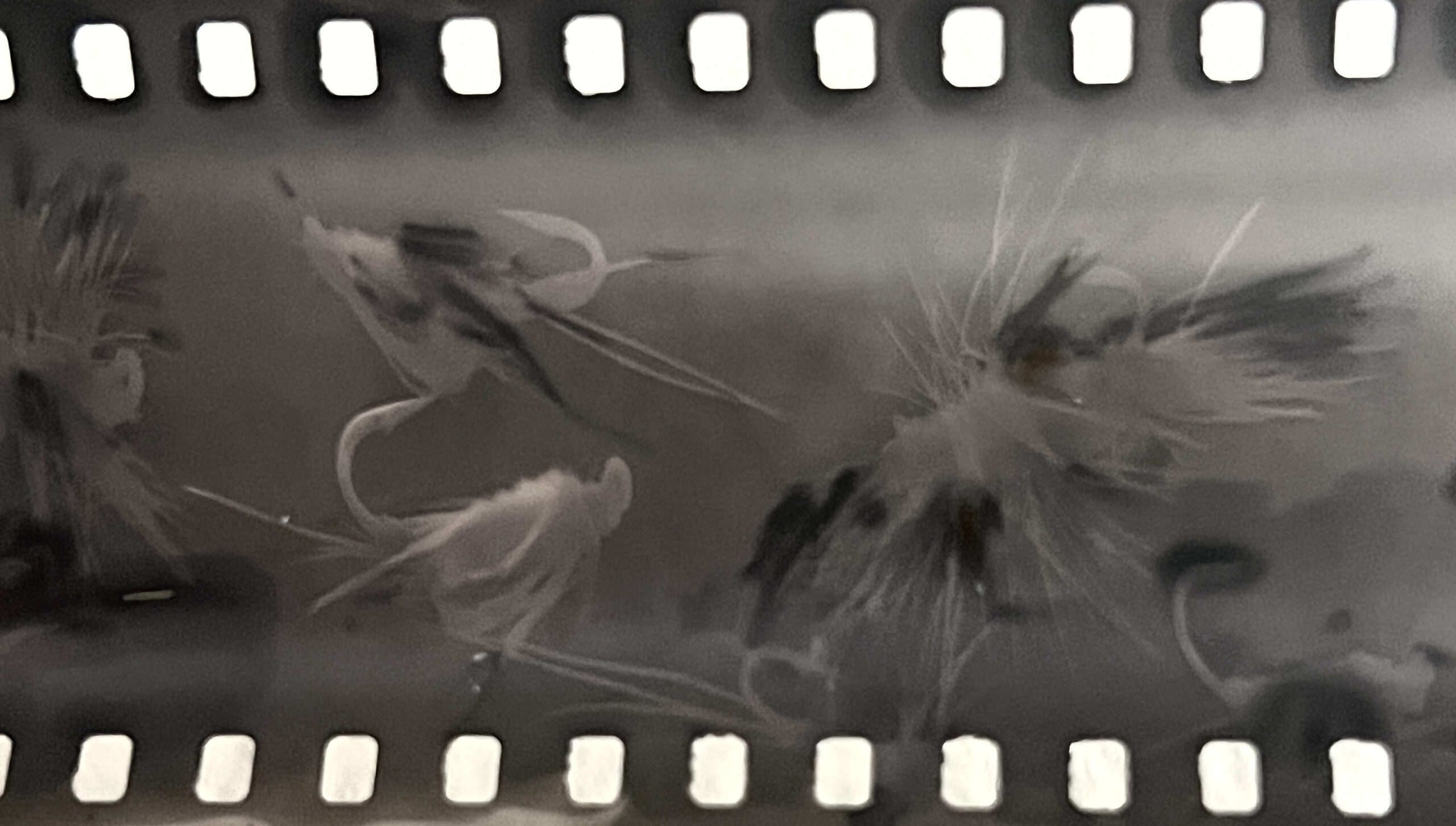
For artists who are well-versed in digital media production, working with 16mm film necessitates adopting a different relationship to both time and control than we normally have with digital tools. Stepping back into analog filmmaking processes reminds us that some images can only be coaxed into being with specific kinds of photochemical and printing processes. Using old cameras, expired or salvaged stock, and handprocessing film with plants and alternative chemistry, invites collaboration with chance and unpredictability. For example, handprocessing allows the randomness of marks and unforeseen “accidents” to participate in a work’s shaping. Not knowing if your film will turn out, or how it will look until after it has been developed, (re-)introduces a necessary slowing down from the digital realm—one that imposes pauses into the processes of becoming. Recording imagery on a handmade pinhole camera or a borrowed 8mm camera; scraping emulsion off of one film strip and pasting it onto another; experimenting with placing bits of plants and tiny objects onto unexposed film in a darkroom—these are just some of the methods used by the Print Generations artists to share agency with the creative process. The results are that these handmade films offer seductive evidence of a surrender to process—the willingness of the artists to not know what will result and their commitment to finding meaning in the alchemical magic of what appears.
Flow Attachment (Tijana Petrovic)
Tijana Petrovic: Visual Continuums
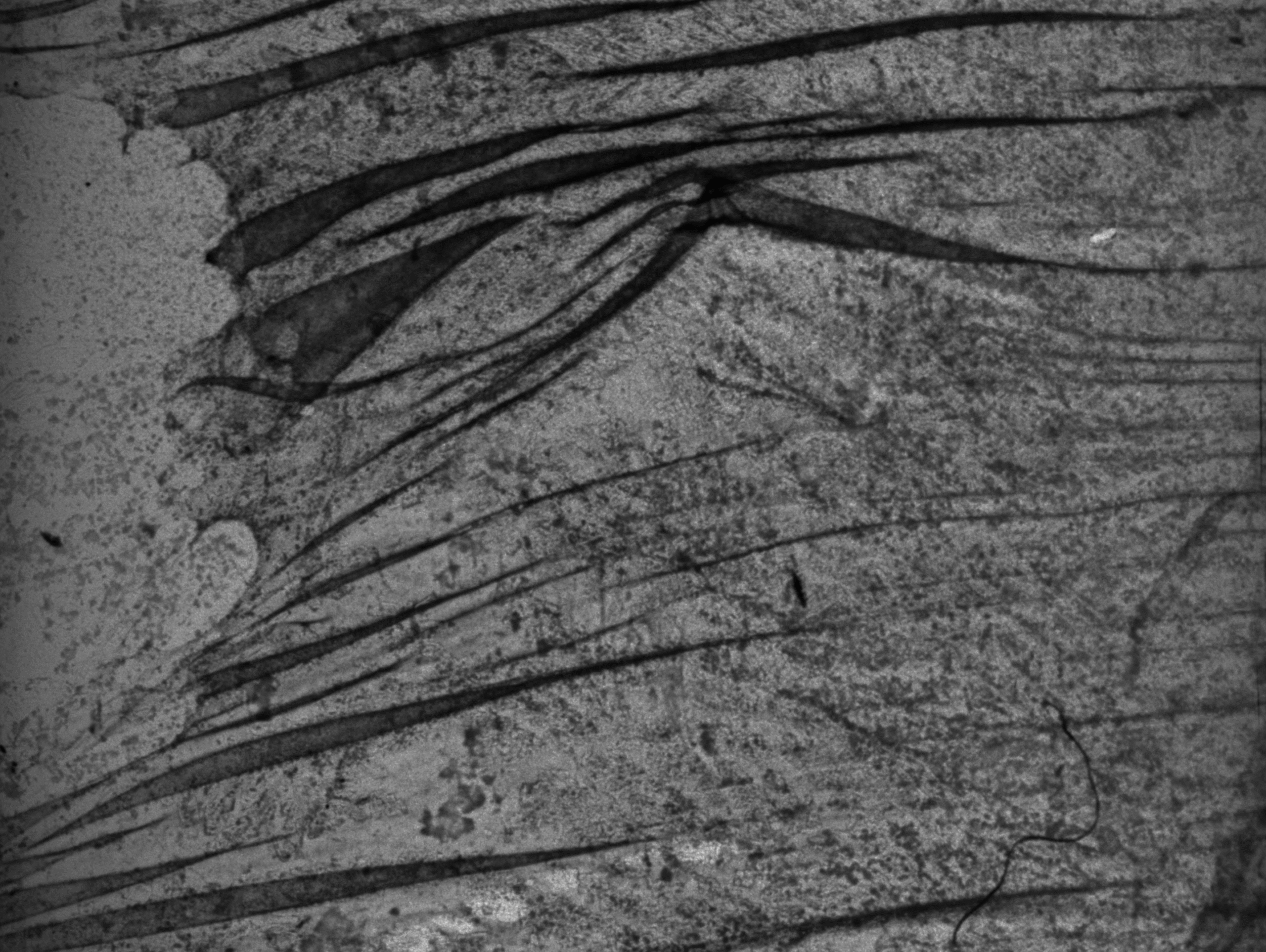
Tijana Petrovic’s Flow Attachment (2026) begins with an image of indeterminacy—a grainy black and white field of subtle movement that might be a picture of the sky or sand or a not quite visible ocean—we can’t be sure. Then, we perceive the sandy beach, and there is a close-up of pockmarked sea foam, bubbles popping. This initial experience of perceptual uncertainty is an introduction to a film that explores the tenuous relationships between proximity and distance, figure and ground, sky and earth, light and shadow, movement and stillness, film grain and sand grains, woven through the film. At one moment, the sky is perceptable as sky only when itis inhabited by tiny bright specks of birds gliding across the grainy frame. These birds are carried by the same wind that creates the ocean’s foam and waves. Then more birds fly through the sky, but now these larger silouhettes are dark figures against the light. Then we are back on the ground, looking at an immovable skeletal remains of a bird half-buried in the sand. Its body is ringed by a broken arc of scattered feathers. What was once moving across the sky is now immobile. Yet, nothing is really still in this landscape of perpetual wind and change. The dead bird is slowly enveloped by blowing sand. This is a landscape of constant flux. As sand accumulates in a pile, it fills up the screen and transforms it into a flattened two-dimensional field of near abstraction.
This first section of Petrovic’s film, a beach landscape, is rendered in a human scale of vision. The handprocessed quality of the footage alludes to an ecological appreciation of the physical nature of the film—evidence of its development. It too has been knocked about and agitated in fluid, an analogy to how the sands of the beach have been developed from rock tumbled in the ocean. But, then the film changes register. Light and dark values in the image flicker on and off to bell-like musical tones. In this second section of the film, we have entered a microscopic, mystical landscape in which sand grains appear like pebbles. Chris Carlson’s soundscore, which in the first section emphasized the natural sounds of the environment, brings an ethereal quality to this magical mode of seeing. But, then, another mode interrupts this lyricism with a sudden rattle. A grid, a mesh screen, squares scurry into being. And then, we are in another landscape entirely. Something like a computer-generated, 3-D x-ray rendering of a microscopic monumental presence suggests at once a boulder and a single grain of sand. This new form of visuality offers intricate details that were clearly not photographed in film or drawn by a human hand. What was once merely a speck on the beach, or a dot that was indistinguishable from so many other dots in each film frame, is now a giant, rendered in superhuman precision—slowly rotating in the center of the frame as if it were a planet or a strange monolith. This strange new, semi-transparent element floats above the celluloid backdrop.
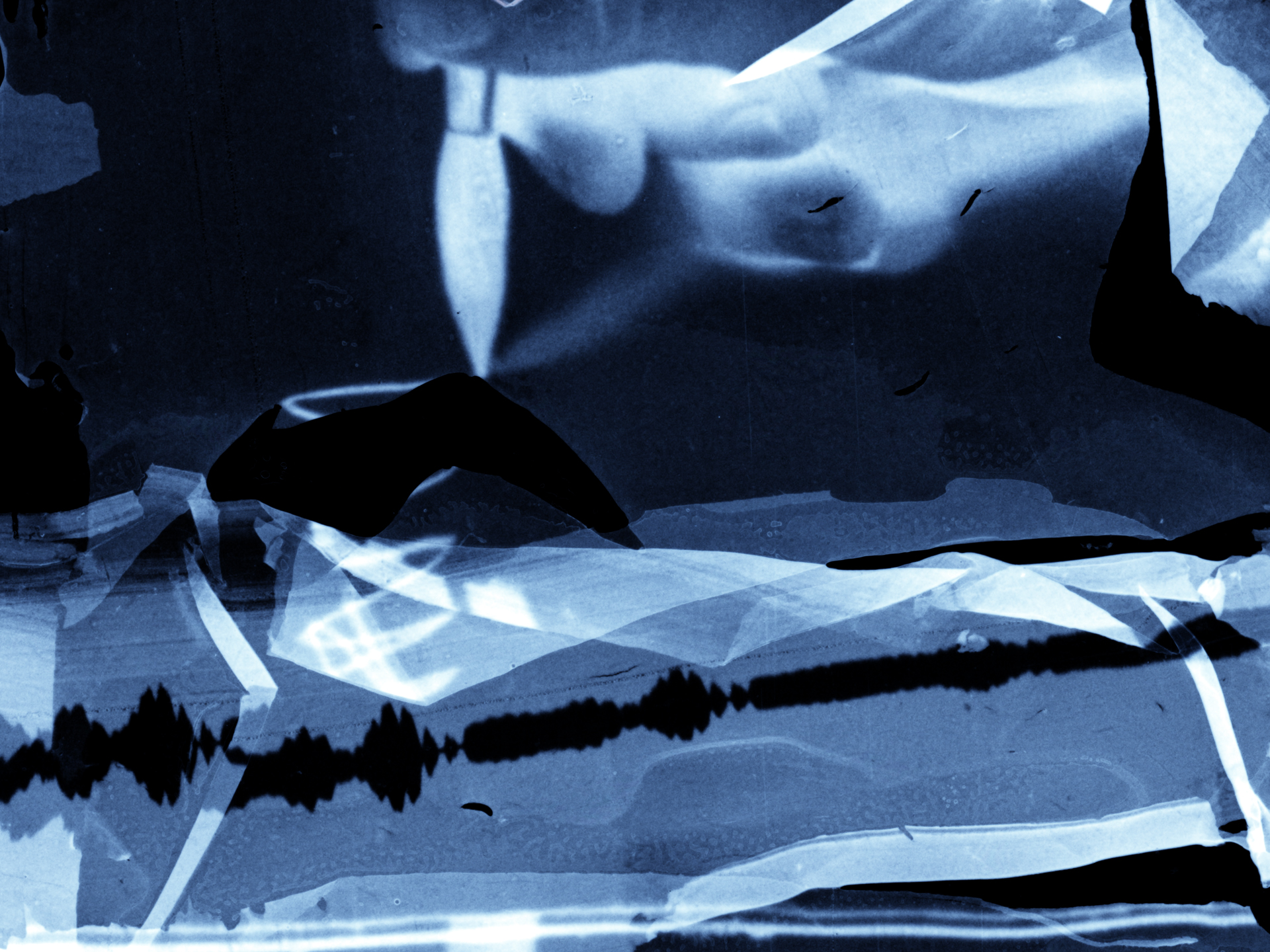
Just as quickly as it appeared, the computer rendering is gone—leaving us to regard a series of abstractions images created on celluloid. These abstractions make me think of aerial landscapes, a shape of a river forking or else, the inside of crystals, or close-ups of tree bark, or the skin of an elephant, or even, cave paintings. These abstract images also refer to the material of the film itself—crumpled emulsion, particles, and glue on film strips. But, whatever these images refer to, the sequence offers a meditation on vision and perception—the experience of shifting perspectives that offer both opacity and surprising moments of clarity. Above all, Flow Attachment is a series of dialogues between figure and ground, negative and positive, representation and abstraction— but also between the materiality of analog and digital forms of image-making. And, while we may think of dark and light, sea and sky, sand and water, and even analog and digital as binary oppositions, in Flow Attachment they cannot be so easily disentangled from each other.
Bay Area Sampler Quilt (Amy Reid)
Amy Reid: Materiality and Pattern—The Labors of Love
For Amy Reid, quilts are not simply beautiful, decorative, handmade blankets to admire and use as bedcovers. They are feminist archives of exquisite skill, labor, forms of sociality, and repositories of traditional knowledge containing ethnically-and geographically-specific histories. Over the course of a number of years, Reid has been focusing on this undertheorized heritage craft in her doctoral research and forthcoming feature documentary film, Grandmother’s Garden. In researching how quilts are expressions of individual genius, occasions for communal gathering, and evidence of resilience in the face of oppression, Reid has amassed a large archive of interviews with quilters and quilt collectors, along with documentation of quilting bees across the country. For this Print Generations commission, Reid orients herself differently to her subject. Inspired by the inventiveness of the quilting craft, she set about to experiment with how she could make a film be like a quilt. Bay Area Sampler Quilt (2026) and the short 16mm Film Quilt (2026) are the results of Reid’s artistic explorations.
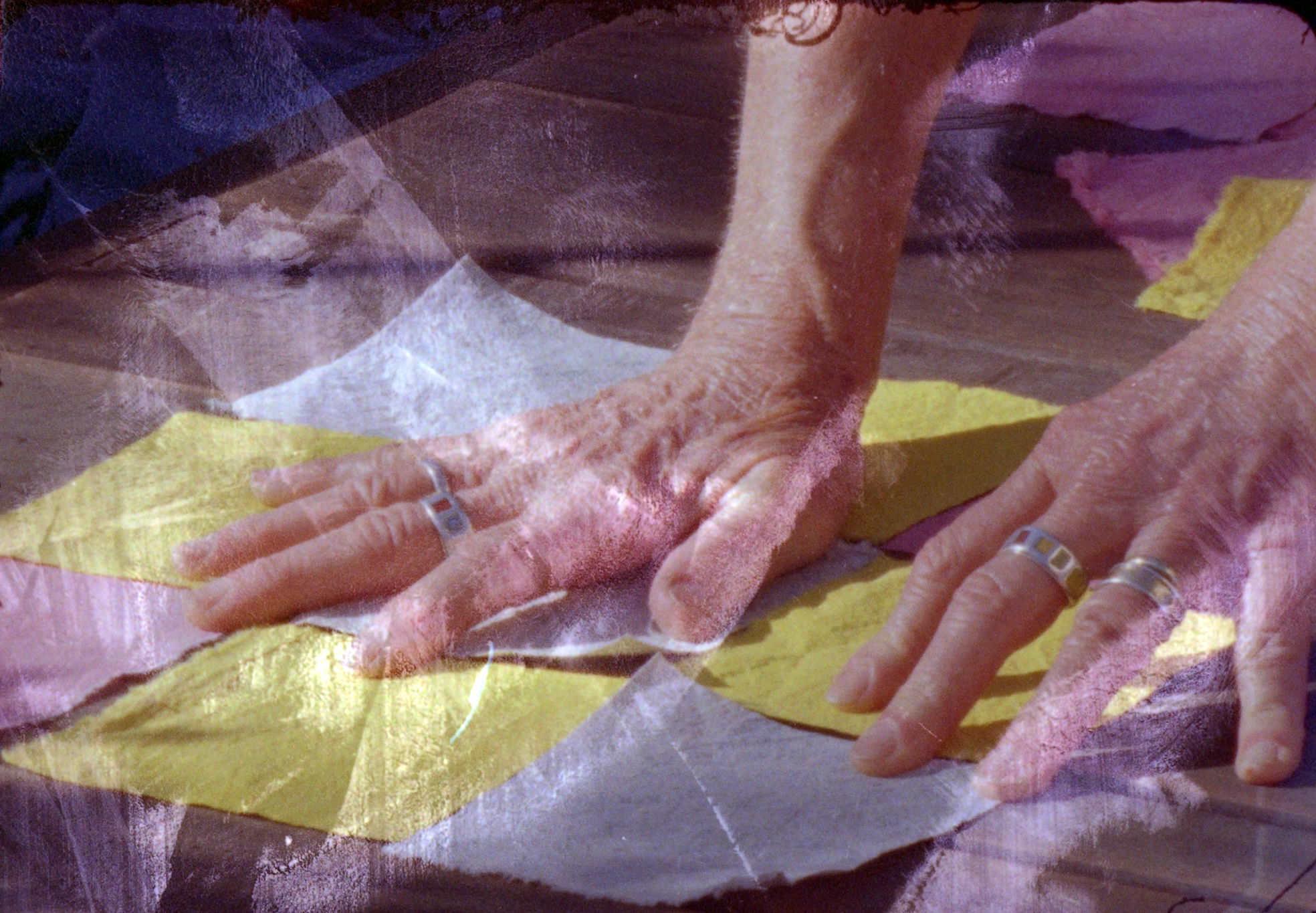
True to its title, Bay Area Sampler Quilt is composed of short examples of Reid’s well-honed approach to filming quilts with their quilters. Edited together in a repeating visual rhythm that calls to mind the geometric arrangements of colored fabrics used in many quilts, the film begins with a color sequence showing loose squares of fabric arranged in a pattern on the table, being picked up, one by one, as if to say—we are now going to begin the process of quilting. Then, there is a blank screen, an interlude from the quilt imagery, which showcases the colorful markings and splotches of the handprocessed film itself. This short moment displays the materiality of the celluloid—like the fabric backing that will hold together this film quilt. When the film returns to quilt imagery, the first one we see is a busy, intricate pattern of tight, colorful small squares, made more pixel-like when shown as a complete object, hung from a clothesline in the backyard waving in the air. A hand uses a scissor to cut through batting. Then we see a new quilt: a rainbow of interlocking V shapes. Seen first as details, then as an full entity—this quilt’s unique and colorfully exuberant pattern is revealed. Hands operate a sewing machine, then there is a wonderfully inventive quilt made with leaf shapes. Hands stitch fabric, hands guide fabric through a sewing machine, then another quilt appears, details at first, followed by a view of the complete work. Quilts are held up above a quilter’s head, or held out in front of bodies standing in front of a house, or hanging down over the side of a house from the second floor.
As I take in these diverse samples of quilting prowess, I marvel at the intricate craft and creativity on display. And yet, Reid’s homemade film aesthetic and the informal way in which the quilters present their work to the camera suggest a personable humbleness to this endeavor. The everyday, casualness contrasts starkly with the skill, dedication, and prowess on display—a contrast that is woven through this film’s form and content—its pattern and fabric. The older women responsible doing this labor often hold their quilts up in front of them, as if to say, I am not the focus, it is my quilt that speaks for me. But, if the quilts are the main attraction, itis the hands that are the stars of Reid’s film. Hands cutting with scissors, hands operating sewing machines, hands stitching cloth, hands holding the tops or sides of quilts. Reid’s emphasis on hands foregrounds her attention to the labor of the quilters; continually returning us to consider the finished work in relationship to the process of its creation. Tyler Bell’s wonderfully energetic, minimalist score emphasizes the expressive, repetitive nature of quilting as a craft. The rhythmic insistence of Bell’s piano, interrupted by surprising moments of pause, extends the film’s rhythmic visuality and suggests the explosive and soothing sounds of the stop/start of sewing machines at work.
Reid’s project leads me to consider some of the striking similarities between quilting and 16mm filmmaking. Both were popular pastimes aimed at women homemakers, melding utilitarian function with art. Both can evoke nostalgia for lost past. And both 16mm filmmaking and quilting have a greatly diminished role in everyday life than they played in earlier times. Both have a small but loyal coterie of practitioners who often gather together to share their work in specialized groups. Like the small community of committed DIY filmmakers who have banded together to create the Black Hole Collective Film Lab to share knowledge and resources, quilters can often be found working together in supportive groups or at events, called quilting bees. It is this communal aspect of quilting that is emphasized by the final section of Reid’s film in which we see groups of quilters working and socializing together.
One of the most concrete ways that Reid allegorizes quilting is the use of the “split 16” technique to produce a quadrant of images within each frame. While other feminist filmmakers have used this technique to create a 4-up image, Reid employs the technique in her own manner. She films quilt squares as one-side up and the other upside-down to produce a kind of mirror image effect between the left and right sides of the frame. In this way, Reid’s kaleidoscope-like grid pattern of squares within squares create a visual analog to a geometric quilt block. Not only is the materiality of celluloid emphasized with hand-processing, but the images themselves—both the representational images of quilts and sewing and the abstraction of the split 16 image—demonstrate the film as quilt analogy. In Bay Area Sampler Quilt, Reid’s admiration for the labor and love that the quilters have for their quilts is expressed through her own labor and attention to the handmade filmmaking process. In the last minutes of the film that feature groups of senior citizens sewing and socializing, Reid’s camera maintains a respectful distance. We regard the group gathering from across the room as a group working together, without being able to see their output. In the end, Reid’s emphasis on process and community stitches together an appreciation of the quilt with a devoted regard for the quilters who are behind them.
Swing Swish Sway (TT Takemoto)
TT Takemoto: Speculation, Resistance, and Chance
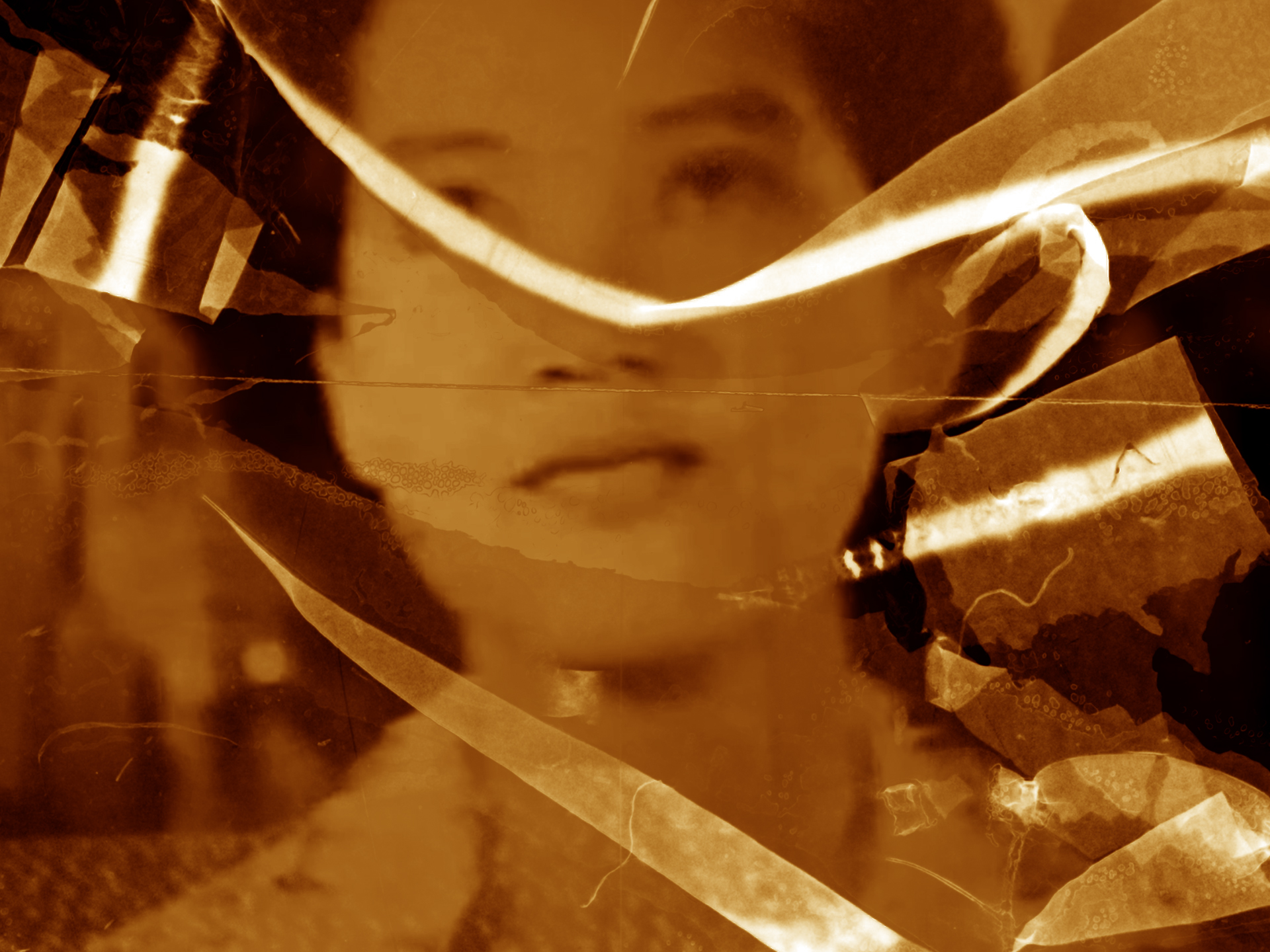
Like Reid, TT Takemoto finds inspiration in overlooked and underrepresented subjects. But for Takemoto, their work is inspired by a lack of knowledge—picking up on hints and fragments of a little documented Asian American queer history. Takemoto could find little information about Rosalie “Rose” Bamberg, the working class Filipina American who co-founded the Daughters of Bilitis (DOB), the first documented lesbian political rights organization in the US. But, it is the paucity of information about her chosen subject that becomes the impetus for Takemoto’s imaginative approach to filmmaking. Mining imagery from “the trash of the past,” Takemoto literally presses them into service to create a speculative fantasy. Scraping selected images off of the emulsion of one film strip and pasting the salvaged, distorted fragments onto a new one, Takemoto works with the meticulous attention of a draftsperson. These constructed filmstrips then becomes the images that Takemoto recombines and layers using a contact printer. The results of Takemoto’s patient process of iterative metamorphosis is a collaboration with the whims of emulsion, glue, chemistry, and printer.
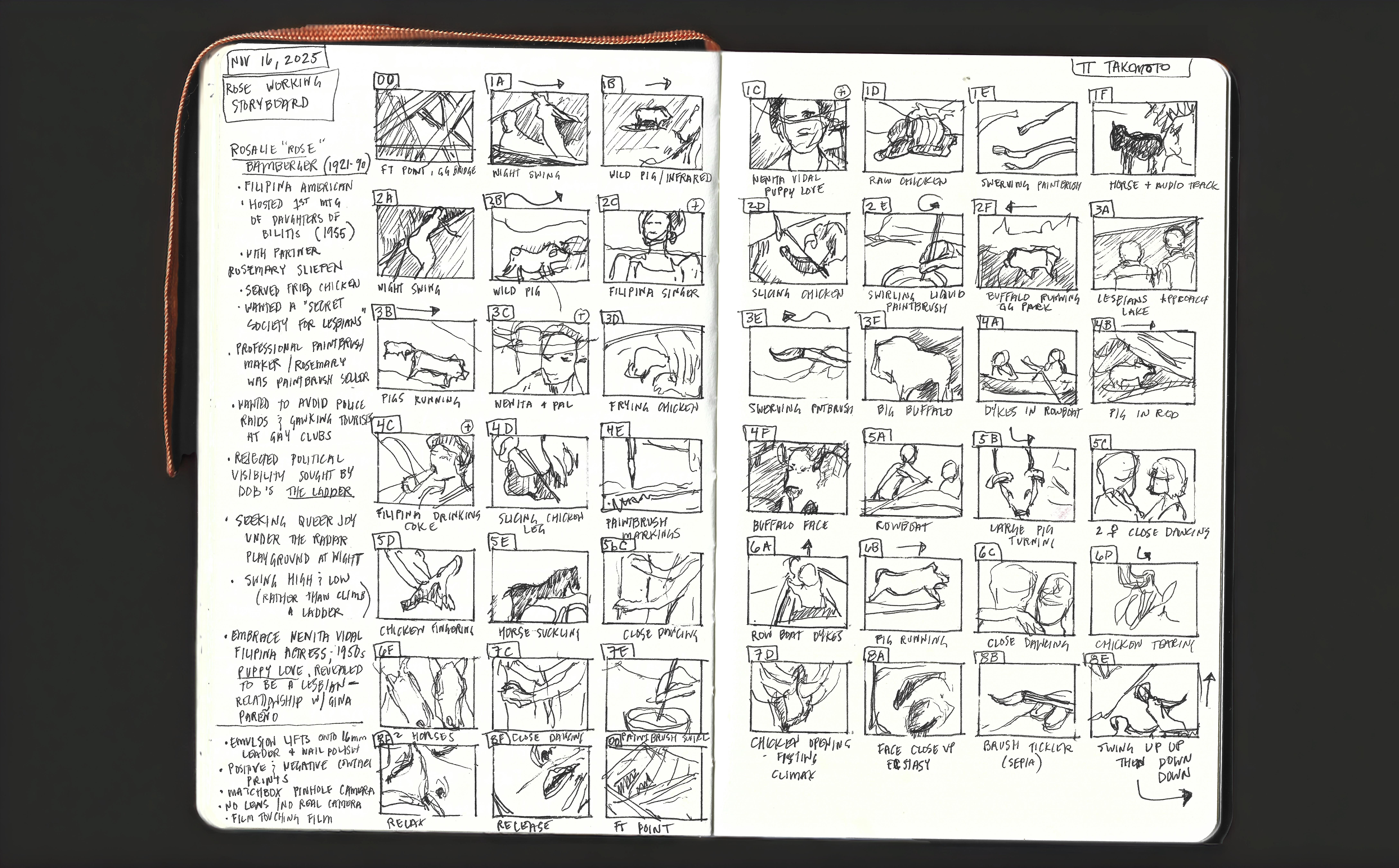
Takemoto’s editing process is equally engaged with change. During the process of finding, lifting, and recontextualizing found footage, Takemoto identifies a set of symbols that will come to represent specific imagined moments in “Rose’s” life. These symbols are the repeatable elements in a visual score that Takemoto devises in order to guide the appearance and timing of the symbolic images into a rhythmic choreography. [See an example of Takemoto’s sketchbook storyboards below.] And while the meaning of these chosen symbols are important for Takemoto’s creative process, the artist’s goal is to be evocative rather than explicit. During our studio visit, they explain: “I need the story so I can make the work. But, I don’t need people to know what that story is.” While admiring the lush, painterly qualities of their work, I was interested to learn that Takemoto had originally trained as a painter with the Fluxus artist Geoffrey Hendrix—a key influence in their development of this “chance operations” editing method guided by a visual score.
Film storyboard journal sketches by TT Takemoto
While Takemoto’s work is developed using 16mm filmmaking processes, like Petrović and Reid, they finish their work digitally, adjusting the speed, adding color, and finally collaborating with their sound designer, Kadet Kuhne. The resulting digital-film hybrid is an evocative symphony of queer jubilance—bringing to consciousness a life that may have no other visual representation in the archive of queer history. As a film that “aims to recover and amplify submerged moments of queer joy and resistance,” Swing Swish Sway (2026) also suggests a reevaluation of presumptions about queer political history. Knowing only that Rose and her partner disappeared from DOB after it became a political organization, Takemoto imagines that these two working class lesbians simply wanted a place to gather socially with other gay women in order to eat and dance and party. Perhaps they had no interest in being political activists. In Takemoto’s film, Rose’s existence is a reminder that queer history is a palette that resists certainty.
This Print Generations program orients us toward indeterminacy. With Petrovic, this is a phenomenological indeterminacy in which the act of making images cannot be extricated from technology. For Reid, the distinction between quilter and quilt—labor and product dissolves. And for Takemoto, the indeterminacy begins with an unknowability about their subject’s life. Each filmmaker demonstrates the enduring allure of handmade, experimental film—for filmmaker and audience alike—to create films that allude narrative or expository determinacy. Instead they offer a chance to luxuriate in the expressiveness of a medium in which feelings and perceptions connect us to the world.
S Topiary Landberg is an Oakland based artist, writer, and curator who teaches at UC Santa Cruz.